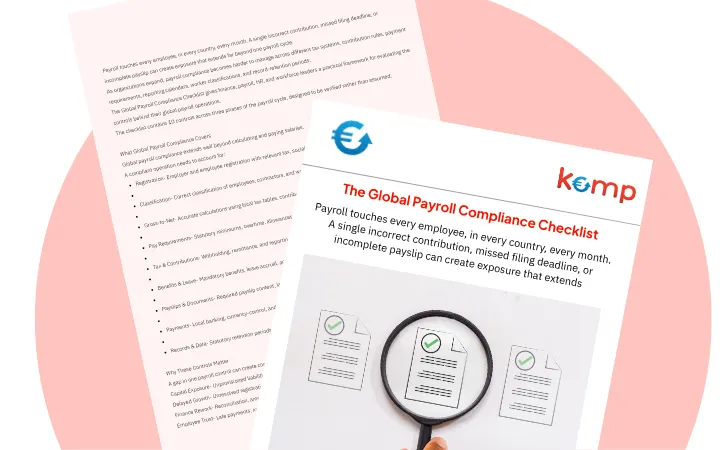
Payroll touches every employee, in every country, every month. A single incorrect contribution, missed filing deadline, or incomplete payslip can create exposure that extends far beyond one payroll cycle.
As organizations expand, payroll compliance becomes harder to manage across different tax systems, contribution rules, payment requirements, reporting calendars, worker classifications, and record-retention periods.
The Global Payroll Compliance Checklist gives finance, payroll, HR, and workforce leaders a practical framework for evaluating the controls behind their global payroll operations.
The checklist contains 10 controls across three phases of the payroll cycle, designed to be verified rather than assumed.
What Global Payroll Compliance Covers
Global payroll compliance extends well beyond calculating and paying salaries.
A compliant operation needs to account for:
- Registration: Employer and employee registration with relevant tax, social security, and labor authorities.
- Classification: Correct classification of employees, contractors, and workers engaged through an EOR.
- Gross-to-Net: Accurate calculations using local tax tables, contribution bases, caps, and applicable reliefs.
- Pay Requirements: Statutory minimums, overtime, allowances, and sector-specific entitlements.
- Tax & Contributions: Withholding, remittance, and reporting according to each authority's calendar.
- Benefits & Leave: Mandatory benefits, leave accrual, and applicable severance or end-of-service obligations.
- Payslips & Documents: Required payslip content, language, format, delivery method, and year-end documentation.
- Payments: Local banking, currency-control, and anti-money-laundering requirements.
- Records & Data: Statutory retention periods and appropriate protection of payroll information.
Why These Controls Matter
A gap in one payroll control can create consequences far beyond a single correction.
Capital Exposure- Unprovisioned liabilities, back payments, penalties, and legal costs can directly affect expansion budgets.
Delayed Growth- Unresolved registrations, tax issues, or blocked payments can delay entry into new markets.
Finance Rework- Reconciliation, amended filings, and manual corrections consume finance capacity.
Employee Trust- Late payments, incorrect amounts, or incomplete payslips can directly affect employee confidence and retention.
How Komp Supports the Compliance Framework
The checklist is designed around controls that need to work together, not as isolated payroll tasks.
Komp connects these controls across its workforce operating model:
- One Payroll Process: Komp PayOps runs countries through a consistent calendar and approval chain while applying local statutory calculations.
- One Workforce Record: Komp Activate + Workforce + TimeOps + PayOps connect the employment record from hiring through time, leave, and payroll.
- Intelligent Classification: Classification Intelligence evaluates worker engagements against applicable local rules and routes recommendations for human review.
- Continuous Compliance: Compliance Intelligence and AI Agent Swarms monitor regulatory developments and surface changes before they affect payroll.
- Controlled Payments: Komp’s payment infrastructure connects settlement status with payroll records for greater payment visibility.
- Audit-Ready Records: Payroll documents, approvals, filings, and history remain connected to the relevant employee record.
What You'll Get From the Checklist
Inside the complete checklist, you’ll find:
- The 10 core global payroll compliance controls
- A three-phase framework for building, running, and closing the payroll cycle
- Key considerations for worker classification
- Statutory pay and contribution requirements
- Payment and banking controls
- Tax withholding and filing considerations
- Payslip compliance requirements
- Payroll record-retention principles
- Legislative-change monitoring requirements
- A final 10-point checklist for operational review
The full guide is designed to help teams verify each control rather than assume it is covered.