Guide

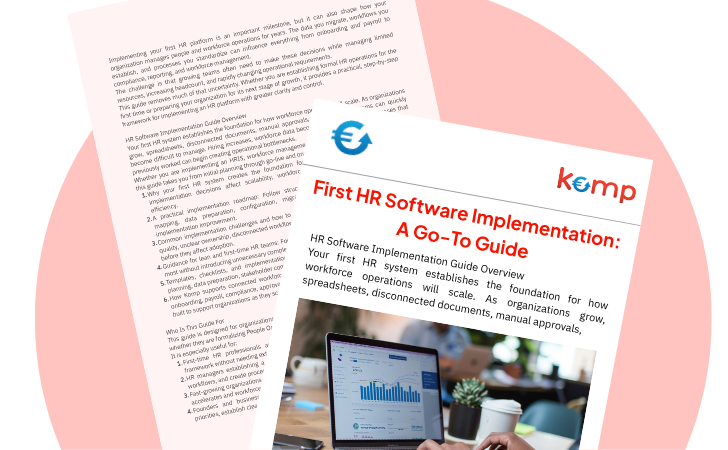
First HR Software Implementation: A Go-To Guide

Implementing your first HR platform is an important milestone, but it can also shape how your organization manages people and workforce operations for years. The data you migrate, workflows you establish, and processes you standardize can influence everything from onboarding and payroll to compliance, reporting, and workforce management.

The challenge is that growing teams often need to make these decisions while managing limited resources, increasing headcount, and rapidly changing operational requirements.

This guide removes much of that uncertainty. Whether you are establishing formal HR operations for the first time or preparing your organization for its next stage of growth, it provides a practical, step-by-step framework for implementing an HR platform with greater clarity and control.

HR Software Implementation Guide Overview

Your first HR system establishes the foundation for how workforce operations will scale. As organizations grow, spreadsheets, disconnected documents, manual approvals, and separate systems can quickly become difficult to manage. Hiring increases, workforce data becomes fragmented, and processes that previously worked can begin creating operational bottlenecks.

Whether you are implementing an HRIS, workforce management system, or broader people platform, this guide takes you from initial planning through go-live and ongoing improvement. Inside, we cover:

  1. Why your first HR system creates the foundation for future growth: Understand how early implementation decisions affect scalability, workforce visibility, compliance, and operational efficiency.  
  1. A practical implementation roadmap: Follow structured stages covering objectives, workflow mapping, data preparation, configuration, migration, testing, training, launch, and post-implementation improvement.  
  1. Common implementation challenges and how to prevent them: Identify issues such as poor data quality, unclear ownership, disconnected workflows, insufficient testing, and limited user preparation before they affect adoption.  
  1. Guidance for lean and first-time HR teams: Focus resources on the processes and data that matter most without introducing unnecessary complexity during the initial rollout.  
  1. Templates, checklists, and implementation resources: Use practical tools for implementation planning, data preparation, stakeholder communication, training, testing, and launch readiness.  
  1. How Komp supports connected workforce operations: Explore how Komp brings workforce data, onboarding, payroll, compliance, approvals, and reporting into one connected operating environment built to support organizations as they scale.  

Who Is This Guide For

This guide is designed for organizations implementing their first HR or workforce management system, whether they are formalizing People Operations or building infrastructure for future growth.

It is especially useful for:

  1. First-time HR professionals and People Operations leads: Get a structured implementation framework without needing extensive previous system implementation experience.  
  1. HR managers establishing a workforce system of record: Improve data consistency, standardize workflows, and create processes capable of supporting future growth.  
  1. Fast-growing organizations expanding across teams or markets: Build greater consistency as hiring accelerates and workforce operations become more complex.  
  1. Founders and business leaders managing early HR operations: Understand implementation priorities, establish clear ownership, and avoid unnecessary operational rework.  

FAQs

Common signals include accelerating headcount, inconsistent onboarding, workforce information spread across spreadsheets or documents, manual payroll inputs, limited reporting, and increasing compliance requirements.

When administrative processes begin slowing HR or creating unreliable workforce data, implementing a structured system becomes increasingly valuable.

HR software implementation involves configuring a platform around your organization’s workforce processes, policies, data, and operating requirements.

It typically includes defining objectives, mapping existing workflows, preparing and migrating data, configuring permissions and processes, testing the system, training users, launching the platform, and reviewing performance after go-live.

A successful implementation should create reliable workforce data, usable workflows, clear ownership, and an operating foundation that can scale with the organization.

Implementation timelines depend on workforce size, data quality, integrations, workflow complexity, configuration requirements, and the platform being introduced.

Simpler implementations may take several weeks, while complex enterprise or multi-country deployments can take considerably longer. Data preparation and stakeholder coordination are often significant factors in the overall timeline.

The implementation team should remain focused while representing the functions affected by the new system. Typically, this includes an HR or People Operations project owner, an operations or systems stakeholder, and the platform provider’s implementation team.

Finance, IT, Legal, Payroll, or Compliance may also need to participate where integrations, data security, payroll, regulatory requirements, or approvals are involved.

Clear responsibilities are more important than having a large implementation team.

At minimum, organizations should map onboarding, employee changes, offboarding, payroll inputs, time and leave processes, document management, approvals, reporting structures, and compliance-related workflows.

Understanding how these processes currently operate makes it easier to determine how they should work within the new platform.

Poor workforce data is one of the most significant implementation risks.

Duplicate, incomplete, inconsistent, or outdated information can create migration errors, reporting problems, workflow failures, and low user confidence.

Reviewing and cleaning workforce data before migration can substantially reduce rework after launch.

The right platform should simplify core processes while supporting the organization’s future operating requirements.

Consider implementation support, usability, configurability, integrations, reporting, data governance, compliance capabilities, and scalability.

The platform should reduce manual work, improve workforce visibility, and support the processes your organization expects to manage as it grows.

Successful adoption depends on clear communication, practical training, defined responsibilities, and accessible support during rollout.

Employees and managers should understand why the platform is being introduced, which processes are changing, what actions they need to complete, and where they can get help.

Common problems include migrating poor-quality data, configuring technology before mapping workflows, unclear project ownership, insufficient testing, overcomplicating the initial setup, and failing to prepare managers and employees for the change.

Addressing these areas during implementation planning can reduce disruption after launch.

Small HR teams should prioritize clean workforce data, essential workflows, clear ownership, focused testing, and straightforward employee communication.

Rather than configuring every possible capability immediately, establish a reliable foundation and introduce additional processes as requirements mature.

Choosing a platform that provides connected workflows and implementation support can also reduce the administrative burden on smaller teams.

Komp provides a connected Workforce Operating System for managing workforce data, onboarding, payroll, contractors, compliance, approvals, and reporting.

By bringing these processes into one operating environment, Komp helps organizations reduce fragmented workflows, establish greater workforce visibility, and build an infrastructure that can support increasingly complex global operations as they grow.

Your Details

Realted Resources

Left-pointing arrow icon.
Right-pointing arrow icon.