Guide

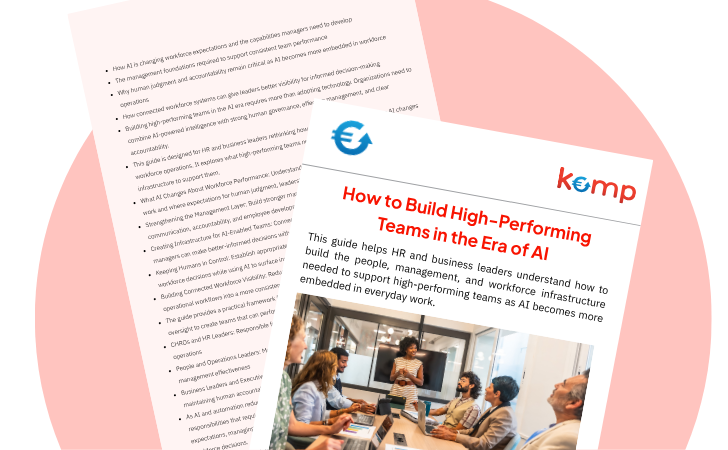
How to Build High-Performing Teams in the Era of AI

AI is changing how work gets done. Teams have access to more automation, intelligence, and workforce data than ever before. But better technology alone does not automatically create better performance.

As AI takes on more repetitive tasks and helps surface information faster, the human side of performance becomes even more important. Managers still need to set expectations, coach effectively, provide meaningful feedback, make informed decisions, and understand what their teams need to succeed.

This guide helps HR and business leaders understand how to build the people, management, and workforce infrastructure needed to support high-performing teams as AI becomes more embedded in everyday work.

What’s inside:

  • How AI is changing workforce expectations and the capabilities managers need to develop
  • The management foundations required to support consistent team performance
  • Why human judgment and accountability remain critical as AI becomes more embedded in workforce operations
  • How connected workforce systems can give leaders better visibility for informed decision-making

Building high-performing teams in the AI era requires more than adopting technology. Organizations need to combine AI-powered intelligence with strong human governance, effective management, and clear accountability.

Inside the guide

This guide is designed for HR and business leaders rethinking how teams should be managed as AI changes workforce operations. It explores what high-performing teams need and how organizations can create the infrastructure to support them.

  • What AI Changes About Workforce Performance: Understand where automation can reduce administrative work and where expectations for human judgment, leadership, and decision-making increase.
  • Strengthening the Management Layer: Build stronger manager capabilities around coaching, feedback, communication, accountability, and employee development.
  • Creating Infrastructure for AI-Enabled Teams: Connect workforce information, processes, and insights so managers can make better-informed decisions without adding administrative complexity.
  • Keeping Humans in Control: Establish appropriate human review and governance around important workforce decisions while using AI to surface insights and recommended actions.
  • Building Connected Workforce Visibility: Reduce fragmented information by bringing workforce data and operational workflows into a more consistent environment.

The guide provides a practical framework for combining technology, management capability, and human oversight to create teams that can perform effectively as AI becomes a larger part of work.

Who is this guide for?

  • CHROs and HR Leaders: Responsible for workforce strategy, organizational performance, and global people operations
  • People and Operations Leaders: Managing distributed teams and looking to improve workforce visibility and management effectiveness
  • Business Leaders and Executives: Determining how AI should support workforce productivity while maintaining human accountability

FAQs

As AI and automation reduce repetitive administrative work, managers can spend more time on responsibilities that require human judgment. These include coaching, giving meaningful feedback, setting expectations, managing difficult conversations, understanding team dynamics, and making informed workforce decisions.

Technology can provide information and recommendations, but managers remain responsible for interpreting context and deciding how to act.

AI adoption focuses on whether technology is being introduced and used. Workforce performance depends on whether that technology actually helps people and managers work more effectively.

Organizations can implement AI successfully from a technical perspective without improving performance if managers lack clear processes, appropriate data, or the capabilities needed to translate AI-supported insights into meaningful action.

When workforce information is fragmented across different systems, managers may have incomplete visibility and HR teams spend additional time coordinating data and processes.

A more connected workforce environment can bring relevant information and workflows together, helping managers understand workforce activity more clearly while reducing unnecessary administrative coordination.

Workforce decisions can affect employment, compliance, compensation, performance, and employee experience. AI can help identify patterns, surface risks, and recommend actions, but important decisions should remain subject to appropriate human review.

A human-in-the-loop approach allows organizations to benefit from AI-powered intelligence while maintaining accountability and contextual judgment.

Start by identifying where managers and HR teams spend unnecessary time on repetitive administration, disconnected systems, and manual information gathering.

Organizations can then determine which processes can be automated or connected while identifying the decisions that should remain under human control. This creates a clearer foundation before introducing more advanced AI capabilities.

Operational improvements from automation and connected workflows can begin relatively quickly, but stronger management capability and organizational behavior develop over time.

Organizations should treat the transition as an ongoing operating-model change rather than a one-time technology implementation, continuously reviewing manager effectiveness, workforce outcomes, and how AI is being used to support human decision-making.

Your Details

Realted Resources

Left-pointing arrow icon.
Right-pointing arrow icon.