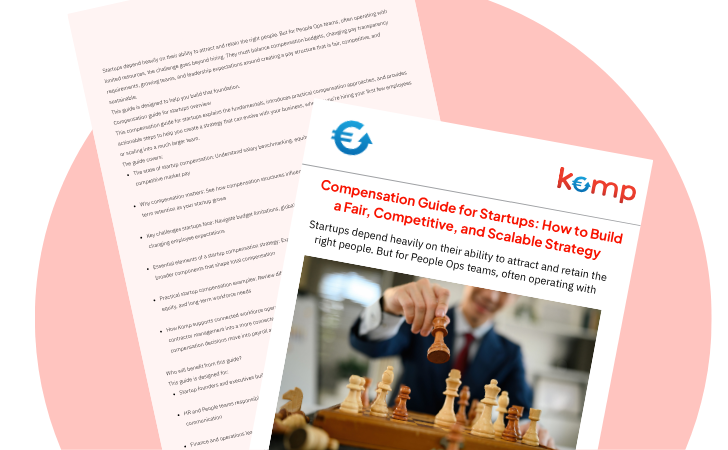
Compensation Guide for Startups: How to Build a Fair, Competitive, and Scalable Strategy
Startups depend heavily on their ability to attract and retain the right people. But for People Ops teams, often operating with limited resources, the challenge goes beyond hiring. They must balance compensation budgets, changing pay transparency requirements, growing teams, and leadership expectations around creating a pay structure that is fair, competitive, and sustainable.
This guide is designed to help you build that foundation.
Compensation guide for startups overview
This compensation guide for startups explains the fundamentals, introduces practical compensation approaches, and provides actionable steps to help you create a strategy that can evolve with your business, whether you’re hiring your first few employees or scaling into a much larger team.
The guide covers:
The state of startup compensation: Understand salary benchmarking, equity considerations, and how startups evaluate competitive market pay
Why compensation matters: See how compensation structures influence offer acceptance, employee expectations, and long-term retention as your startup grows
Key challenges startups face: Navigate budget limitations, global workforce compliance, pay transparency requirements, and changing employee expectations
Essential elements of a startup compensation strategy: Explore salary ranges, equity allocation, benefits, incentives, and the broader components that shape total compensation
Practical startup compensation examples: Review different approaches companies can use to balance cash compensation, equity, and long-term workforce needs
How Komp supports connected workforce operations: Bring workforce information, payroll, compliance workflows, EOR, and contractor management into a more connected operating environment, helping HR and Finance maintain greater visibility as compensation decisions move into payroll and workforce processes
Who will benefit from this guide?
This guide is designed for:
Startup founders and executives building a compensation framework that supports business priorities and future growth
HR and People teams responsible for salary structures, equity considerations, workforce compliance, and employee communication
Finance and operations leaders overseeing payroll costs, workforce budgets, and scalable compensation processes
Investors and advisors helping early-stage businesses establish sustainable and competitive workforce practices
Key terms for startup compensation
Startup Compensation Terms
Key term
Definition
How it relates to a startup compensation strategy
Employee equity
Ownership offered to employees as part of their overall compensation package, giving them a financial interest in the future value of the company.
Startups may use equity alongside cash compensation to attract talent while managing limited early-stage budgets.
Stock options
The right to purchase company shares at a predetermined price in the future, typically once specific vesting conditions have been met.
Can align employee incentives with the long-term growth of the startup.
Vesting schedule
The period over which employees gradually earn the equity or options granted to them.
Encourages long-term commitment and helps startups structure equity rewards over time. Four-year schedules with a one-year cliff are commonly used, although arrangements vary.
(Year) cliff
An initial period during which no equity becomes vested. Once the cliff is reached, an agreed portion may vest, with the remainder typically vesting over time.
Helps companies avoid granting substantial vested equity to employees who leave shortly after joining.
Strike price
The agreed price at which an employee may purchase shares through their stock options.
Influences the potential future value employees may realize from their options and contributes to understanding total compensation.
Stock price
The value assigned to a company's shares. For private startups, this may be influenced by formal valuations or financing events; for public companies, it reflects market trading value.
The stock price affects the value of equity-based compensation and can become an important consideration alongside cash compensation.
Total compensation
The combined value of an employee's salary, bonuses, equity benefits, and other forms of rewards.
Helps startups evaluate the complete value of an employment offer rather than comparing salary alone.
Company valuation
An estimate of the company's overall value, often influenced by financing rounds, business performance, or formal valuation processes.
Can affect the perceived and potential future value of employee equity.
Market rate compensation
Compensation levels based on comparable roles, skills, industries, locations, and labor-market conditions.
Helps startups build pay structures that remain competitive when attracting and retaining talent.
Base salary
The fixed cash compensation an employee receives for their role, excluding bonuses, equity, and other variable rewards.
Usually forms the core of an employee's compensation package and may be combined with equity or incentives in startup environments.
Whether you are hiring your first team members or expanding across markets, building a clear compensation structure early can help you scale with greater consistency and confidence.
FAQs
Early-stage startups commonly use a combination of base salary, equity, and variable incentives. Because cash resources may be more limited than at established companies, some startups use equity to strengthen the overall value of the offer.
The right structure depends on funding, cash flow, role requirements, market benchmarks, and applicable employment and minimum-pay requirements.
Startups generally fund employee compensation through a combination of:
Venture capital or angel investment.
Business revenue and operating cash flow.
Carefully structured salary and equity packages.
Lean headcount and disciplined workforce planning.
Some companies balance competitive but controlled base salaries with equity, flexibility, and other benefits. Whatever approach is used, compensation should remain compliant with local employment, payroll, and minimum-wage requirements.
Many startups use a mix of base salary, stock options or other equity, bonuses, and benefits to build competitive compensation packages.
Companies that cannot match the cash compensation of larger employers may place greater emphasis on equity participation, growth opportunities, flexibility, or the scope and impact of the role. The overall package should still be transparent, sustainable, and aligned with applicable employment rules.
New businesses may fund payroll through founder capital, operating revenue, external investment, or a combination of financing sources. Compensation structures may also include equity or milestone-linked incentives where appropriate.
However, businesses should ensure that any arrangement complies with local wage, payroll, tax, and employment requirements rather than relying on equity as a substitute where cash compensation is legally required.
Some startups offer bonuses, although they may be less structured in very early-stage companies.
Common approaches can include:
Cash bonuses when budget and performance allow.
Milestone-based incentives linked to defined business or individual outcomes.
Equity refresh grants or retention incentives for selected employees.
Startups often use equity and long-term incentives alongside, or instead of, traditional bonus programs depending on their stage, financial position, and compensation philosophy.
It depends on the startup’s stage, valuation, funding history, role, and existing ownership structure. A 1% stake in a very early-stage company can potentially be meaningful, but its future value is uncertain.
Employees should also consider vesting terms, dilution from future financing, the strike price where stock options are involved, and whether there is a realistic path to liquidity.
For most employees, receiving compensation entirely in equity creates significant financial risk. Equity does not provide guaranteed cash income and may ultimately have little or no value.
There may also be legal requirements around minimum wages, statutory compensation, payroll, or employment terms that prevent businesses from replacing cash salary entirely with equity. Such arrangements are generally more relevant to founders or specific early-stage ownership situations than regular employment.
There is no single standard percentage. A startup CEO’s equity depends heavily on whether they are a founder or later-stage executive, the company’s valuation and funding stage, the existing cap table, investor ownership, and the executive’s role.
Founder CEOs may hold substantial ownership initially, but their percentage can decrease as the company raises capital and issues additional equity.
An IPO can significantly change how companies structure equity compensation because shares may become publicly tradable, subject to applicable restrictions and vesting conditions.
Following an IPO, companies may reassess salary benchmarks, long-term incentives, bonus programs, and equity grants as they compete for talent in a more mature operating environment.
Usually, startups find it difficult to compete with large technology companies purely on guaranteed cash compensation. Larger companies may offer higher salaries, substantial bonuses, and broader benefit programs.
Startups often compete through:
Greater potential equity upside.
Broader responsibilities and faster career development.
Flexibility and greater individual impact.
Well-funded startups may sometimes match or exceed larger-company compensation for highly competitive roles, but this varies substantially by company, function, market, and funding stage.
There is no predictable rate of return for startup equity. The eventual value depends on factors such as:
The percentage of ownership held.
The company stage when the equity was granted.
Future funding and dilution.
Company growth and valuation.
Acquisition, IPO, or other liquidity events.
Startup equity should generally be viewed as uncertain, long-term compensation with both meaningful upside and substantial risk. Its final value may only become clear years later or may never result in a financial return.



.png)




















































.png)