Guide

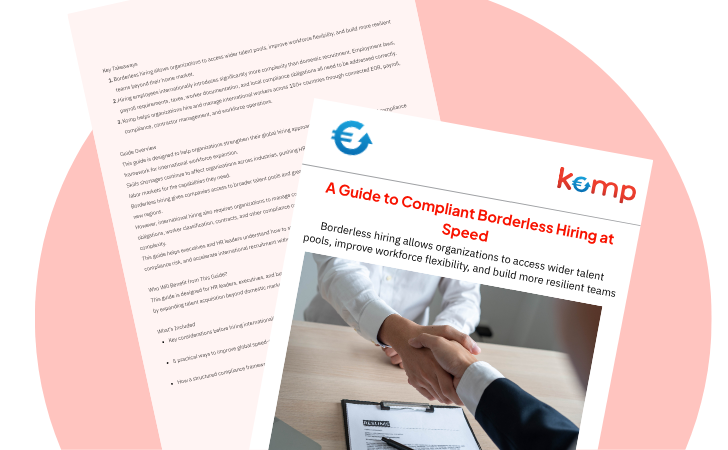
Global Expansion Compliance Guide: Hire Faster, Reduce Risk

  1. Global expansion creates new compliance challenges. Employment laws, payroll requirements, work authorization, worker classification, and data protection rules can vary significantly by country, and mistakes can delay hiring or increase legal and operational risk.  
  1. This guide provides a practical framework for managing compliance as you scale. Learn how to navigate local employment requirements, manage international workers, and maintain stronger payroll, contract, and workforce compliance across markets.  
  1. Built for real-world global workforce operations. Komp supports global hiring, EOR, contractor management, payroll, and compliance across 150+ countries, helping organizations manage international workforce complexity through one connected operating environment.  

Expanding into new countries creates new growth opportunities, but compliance can quickly become one of the biggest barriers to moving efficiently.

Every market has its own employment requirements, payroll obligations, worker classification rules, work authorization processes, and data protection standards. For organizations hiring international employees or managing distributed teams, keeping these requirements aligned across countries can become increasingly difficult.

This Global Expansion Compliance Guide explains the key compliance challenges organizations face when growing internationally and how to approach them more systematically. Whether you are making your first international hire or managing a workforce across multiple regions, the guide helps you reduce risk while maintaining hiring momentum.

What Makes This Guide Different?

This is not a generic overview of international expansion.

The guide focuses on the compliance issues that directly affect global workforce operations, including:

  • How employment contracts and worker classifications differ across jurisdictions
  • What organizations need to consider when managing local labor and employment requirements
  • How global payroll and payroll compliance change across countries
  • When work permits or visas may be required for international workers
  • How data protection, access, and workforce documentation requirements vary between markets

You’ll also learn how workforce models such as Employer of Record (EOR) can help organizations enter new markets, reduce administrative complexity, and support compliant hiring without immediately establishing local entities.

Who Will Benefit from This Guide?

  • HR and People leaders responsible for international hiring and workforce expansion
  • Legal and Compliance teams managing employment requirements, contracts, classification, and workforce risk
  • Finance and Payroll teams overseeing multi-country payroll and workforce compliance
  • Operations leaders coordinating global workforce processes across multiple markets
  • Founders and executives preparing to hire internationally for the first time
  • Anyone responsible for reducing compliance risk while scaling a global workforce

What’s Included?

  • A practical breakdown of the compliance challenges organizations face during global expansion
  • Guidance on employment requirements, worker classification, payroll compliance, and cross-border workforce obligations
  • Considerations around work permits, visas, and international workforce mobility
  • Best practices for maintaining compliance while expanding hiring across markets
  • Practical examples of how organizations can structure global workforce compliance at scale

FAQs

Yes. The guide is designed around global workforce compliance principles that apply across markets while recognizing that employment, payroll, immigration, classification, and data requirements differ by jurisdiction.

Yes. It explains how an Employer of Record can support organizations hiring in countries where they do not have their own employing entity, while helping manage local employment contracts, payroll, statutory obligations, and workforce compliance.

Yes. The guide is relevant both for organizations making their first international hires and for companies already managing distributed teams that want to improve compliance visibility, standardize processes, and reduce fragmentation across countries.

Yes. The guide covers global payroll considerations, country-specific payroll obligations, statutory requirements, and the operational challenges of maintaining accurate and compliant payroll across multiple markets.

No. This guide is intended for educational and informational purposes only. It does not constitute legal, tax, payroll, or immigration advice.

Organizations should consult qualified local professionals for guidance specific to their workforce and jurisdictions.

Your Details

Realted Resources

Left-pointing arrow icon.
Right-pointing arrow icon.