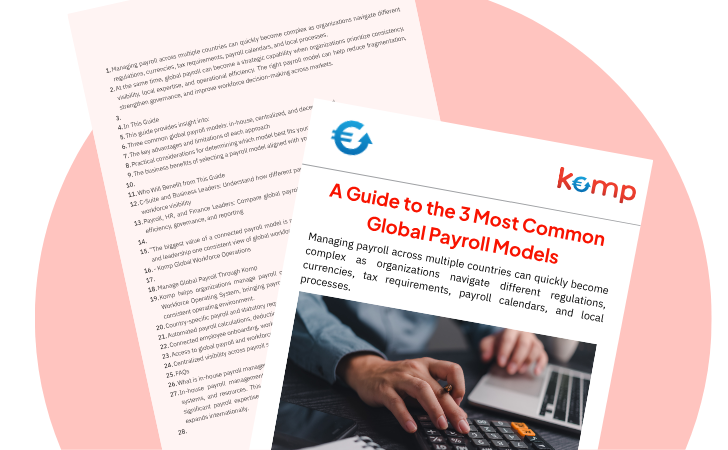
Managing a global workforce means balancing international growth with the realities of country-specific payroll, tax, employment, and compliance requirements. As operations expand across markets, coordinating regional payroll teams and multiple local providers can create fragmented data, inconsistent processes, and limited visibility, making it harder to scale efficiently and make informed workforce decisions.
For enterprise organizations, the stakes are particularly high. A payroll calculation error or missed regulatory requirement can affect more than employee experience; it can create tax exposure, compliance issues, financial penalties, and reputational risk.
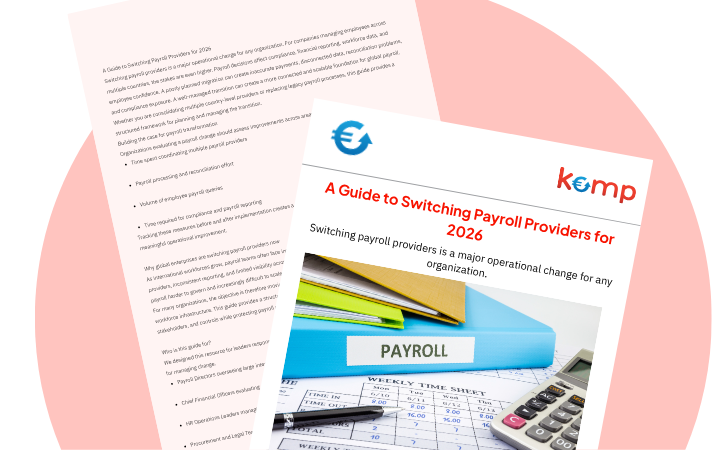
This is why we created the Buyer’s Guide to Global Payroll- a practical framework for Finance, Procurement, HR, and Operations leaders evaluating how to standardize and strengthen multi-country payroll operations.
Whether you are consolidating existing payroll providers or expanding into new markets, this guide helps you evaluate the capabilities required to move from fragmented processes toward a more connected global payroll model.
Guide Overview
This resource goes beyond a basic vendor checklist. It provides a structured framework for evaluating global payroll solutions. Inside, you will find:
- The operational value of centralizing global payroll, funding, data, and reporting
- How embedded compliance capabilities can support more consistent multi-country payroll operations
- What to look for when managing employees, EOR workers, and contractors through connected workforce infrastructure
- Evaluation criteria for country coverage, scalability, implementation, and ongoing service
- A comprehensive checklist covering payroll functionality, integrations, reporting, security, and support
- A structured vendor-evaluation framework to compare different global payroll models and providers
Who Is This Guide For?
We designed this framework for leaders responsible for payroll performance, workforce costs, compliance, and operational scalability across global organizations:
- Finance Directors and CFOs: Seeking consolidated workforce cost data and greater visibility across international payroll
- HR Leaders: Managing multiple worker populations and looking for more consistent workforce and payroll operations
- Procurement and Legal Teams: Evaluating providers across security, privacy, compliance, contractual, and service requirements
- Global Operations Managers: Coordinating regional payroll providers, workflows, reporting, and support across multiple countries
How to Leverage This Guide to Find a Global Payroll Solution
Selecting a global payroll provider is a significant operational decision that requires alignment across Finance, HR, Procurement, Legal, and Operations. This guide structures the evaluation around three key phases:
Phase 1: Discovery
Before comparing providers, establish what your organization requires from an enterprise global payroll solution. The guide explains the core capabilities to assess and why they matter, helping you define clear requirements before entering vendor discussions.
Phase 2: Evaluation and Feature Mapping
Use the payroll evaluation checklist to map providers against your requirements. Review capabilities such as multi-country reporting, employee self-service, payment options, integrations, data protection, approval workflows, compliance support, and payroll visibility.
Phase 3: Vendor Comparison and Selection
The guide provides a structured comparison framework for assessing global payroll providers across operating model, country coverage, implementation, integrations, payments, reporting, user experience, service, security, and commercial structure.
Proven Value Through Global Payroll Consolidation
Organizations operating across multiple countries can accumulate separate payroll providers, reporting formats, approval processes, and reconciliation workflows as they expand. Consolidating these operations can create greater consistency while improving visibility for Finance, HR, and leadership.
Komp helps organizations bring global payroll, workforce data, approvals, compliance, and reporting into one connected operating environment, reducing fragmentation while creating a more consistent view of payroll operations across markets.
“Consolidating our payroll operations gave us more than process efficiency. It gave Finance and HR a clearer, shared view of workforce costs, payroll activity, and approvals across countries, while reducing the coordination required between separate providers.”
- Senior Global Payroll & Finance Leader,
Global Enterprise Organization
Take the Next Step Toward Global Payroll Standardization
Building the right global payroll strategy can reduce manual coordination, improve workforce visibility, and create a more scalable operating model as your organization expands.
Ready to evaluate what a connected global payroll model could look like for your organization?



.png)












































.png)