Guide

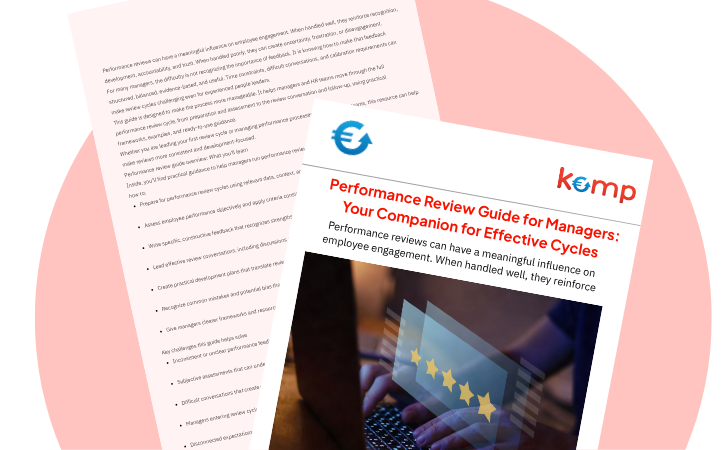
Performance Review Guide for Managers: Your Companion for Effective Cycles

Performance reviews can have a meaningful influence on employee engagement. When handled well, they reinforce recognition, development, accountability, and trust. When handled poorly, they can create uncertainty, frustration, or disengagement.

For many managers, the difficulty is not recognizing the importance of feedback. It is knowing how to make that feedback structured, balanced, evidence-based, and useful. Time constraints, difficult conversations, and calibration requirements can make review cycles challenging even for experienced people leaders.

This guide is designed to make the process more manageable. It helps managers and HR teams move through the full performance review cycle, from preparation and assessment to the review conversation and follow-up, using practical frameworks, examples, and ready-to-use guidance.

Whether you are leading your first review cycle or managing performance processes across multiple teams, this resource can help make reviews more consistent and development-focused.

Performance review guide overview: What you’ll learn

Inside, you’ll find practical guidance to help managers run performance reviews that are structured, fair, and constructive. Learn how to:

  • Prepare for performance review cycles using relevant data, context, and clear expectations.
  • Assess employee performance objectively and apply criteria consistently across teams.
  • Write specific, constructive feedback that recognizes strengths while addressing development areas.
  • Lead effective review conversations, including discussions involving difficult or sensitive feedback.
  • Create practical development plans that translate review feedback into measurable next steps.
  • Recognize common mistakes and potential bias that can reduce trust in the review process.
  • Give managers clearer frameworks and resources for delivering more consistent performance conversations.

Key challenges this guide helps solve

  • Inconsistent or unclear performance feedback between teams
  • Subjective assessments that can undermine confidence in the process
  • Difficult conversations that create defensiveness rather than development
  • Managers entering review cycles without enough preparation or guidance
  • Disconnected expectations between employees, managers, HR, and leadership

Who is this guide for

This guide is built for people responsible for performance, feedback, and employee development:

  • Managers, who want to improve the quality of their feedback and coaching conversations.
  • HR and People teams, looking to provide managers with consistent frameworks, expectations, and guidance.
  • Leaders and department heads, who need greater alignment in how performance is evaluated across teams.

Whether you work in a growing organization or manage teams across a larger global workforce, this guide provides practical support for running performance reviews that encourage development and strengthen employee engagement.

FAQs

When managed effectively, performance reviews can:

  • Strengthen recognition by acknowledging meaningful contributions.
  • Create alignment by connecting individual work with team and business priorities.
  • Surface obstacles that may be affecting employee or team performance.
  • Support development by identifying skills and capabilities that employees can strengthen.
  • Improve retention by demonstrating that employee growth and progression are being considered.

A poorly managed review process can have the opposite effect, which is why consistency, preparation, and communication are important.

An effective performance evaluation typically includes:

  • Consistency: Employees are assessed using comparable criteria, timelines, and processes.
  • Fairness: Evaluations are evidence-based and designed to minimize subjective bias.
  • Clarity: Employees understand expectations, goals, competencies, and how performance is assessed.
  • Actionability: Feedback provides practical direction for improvement and future development.
  • Constructiveness: Employees understand both what they are doing well and what they should focus on next.

HR typically establishes the performance review framework, supports consistency across teams, provides managers with guidance and training, and helps maintain appropriate documentation and governance.

HR can also analyze performance information to identify broader workforce trends, development priorities, and areas where managers may require additional support.

A useful performance remark should be:

  • Specific: Refer to a clear action, behavior, or outcome rather than making a broad statement.
  • Balanced: Recognize achievements while identifying relevant development opportunities.
  • Aligned: Connect feedback with role expectations, goals, competencies, or team priorities.
  • Forward-looking: Explain what continued progress or the next level of performance could look like.

For example: “You consistently met project deadlines this quarter and improved coordination between the delivery and operations teams. The next opportunity is to take greater ownership of stakeholder communication during complex projects.”

Reviewers should generally avoid:

  • Vague statements such as “You did well” without explaining why.
  • Personal judgments that focus on personality rather than workplace behaviors or outcomes.
  • Comparisons with colleagues that can create unnecessary tension or bias.
  • Absolute language such as “You always” or “You never” when the evidence is more nuanced.
  • Unexpected criticism that has not previously been discussed during regular feedback or check-ins.

A strong performance summary should:

  • Summarize achievements against agreed goals and role expectations.
  • Highlight key strengths demonstrated during the review period.
  • Recognize progress made since the previous review or development discussion.
  • Identify areas for development that connect with future responsibilities or career goals.
  • Close with clear next steps and an encouraging direction for the next review period.

Example: “Over the past six months, Jordan has delivered consistently against key project goals and has become a dependable contributor across cross-functional initiatives. Their ability to coordinate priorities and maintain delivery quality has been particularly strong. Developing greater confidence in senior stakeholder communication would support the next stage of their growth and prepare them for broader project ownership.”

A practical performance review meeting can follow this structure:

  1. Set the context: Explain the purpose of the meeting and confirm what will be discussed.
  2. Invite employee reflection: Ask the employee to share accomplishments, challenges, and development priorities.
  3. Provide manager feedback: Discuss performance using specific examples and relevant information.
  4. Discuss perspectives: Explore areas of agreement, development opportunities, and any differences in assessment.
  5. Define next steps: Agree on goals, development priorities, and the support required.
  6. Summarize the conversation: Confirm key takeaways, responsibilities, and follow-up actions.

Five useful questions leaders can ask are:

  1. Which parts of your work have been most meaningful or motivating recently?
  2. What has been the biggest challenge, and what additional support would help?
  3. Where do you think your work has contributed most strongly to team priorities?
  4. Which skills, responsibilities, or experiences would you like to develop next?
  5. Is there anything I could change as your manager to better support your performance and development?

These questions can encourage reflection, clarify development priorities, and create a more two-way performance conversation.

Your Details

Realted Resources

Left-pointing arrow icon.
Right-pointing arrow icon.