Guide

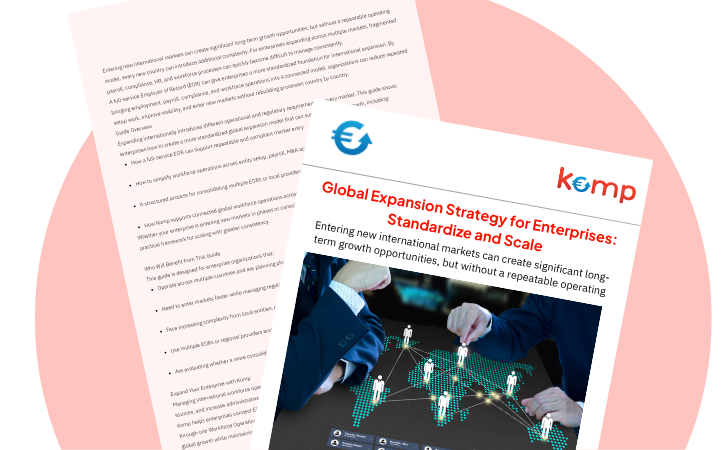
Global Expansion Strategy for Enterprises: Standardize and Scale

Entering new international markets can create significant long-term growth opportunities, but without a repeatable operating model, every new country can introduce additional complexity. For enterprises expanding across multiple markets, fragmented payroll, compliance, HR, and workforce processes can quickly become difficult to manage consistently.

A full-service Employer of Record (EOR) can give enterprises a more standardized foundation for international expansion. By bringing employment, payroll, compliance, and workforce operations into a connected model, organizations can reduce repeated setup work, improve visibility, and enter new markets without rebuilding processes country by country.

Guide Overview

Expanding internationally introduces different operational and regulatory requirements in every market. This guide shows enterprises how to create a more standardized global expansion model that can support continued growth, including:

  • How a full-service EOR can support repeatable and compliant market entry
  • How to simplify workforce operations across entity setup, payroll, M&A activity, and HR
  • A structured process for consolidating multiple EORs or local providers
  • How Komp supports connected global workforce operations across 150+ countries

Whether your enterprise is entering new markets in phases or consolidating an existing network of providers, this guide provides a practical framework for scaling with greater consistency.

Who Will Benefit from This Guide

This guide is designed for enterprise organizations that:

  • Operate across multiple countries and are planning phased or simultaneous international expansion
  • Need to enter markets faster while managing regulatory, operational, and financial risk
  • Face increasing complexity from local entities, payroll requirements, HR processes, and country-specific compliance
  • Use multiple EORs or regional providers and are dealing with fragmented systems and limited workforce visibility
  • Are evaluating whether a more consolidated global employment model can support long-term expansion

Expand Your Enterprise with Komp

Managing international workforce operations through multiple local providers can create inconsistent processes, separate data sources, and increase administrative complexity.

Komp helps enterprises connect EOR, payroll, contractor management, workforce compliance, documentation, and reporting through one Workforce Operating System. This gives HR, Finance, Legal, and Operations teams a more consistent way to manage global growth while maintaining visibility across countries and worker types.

FAQs

A standardized global expansion strategy is a repeatable framework for entering and operating in new countries.

Instead of treating every market as a separate project, organizations define common processes for workforce planning, hiring, payroll, compliance, documentation, and governance. This helps teams avoid rebuilding the operating model each time the business expands.

An EOR can support this approach by providing a consistent employment structure in markets where the organization does not have its own entity.

An Employer of Record becomes the legal employer of workers in countries where the enterprise does not have an employing entity.

The EOR can manage local employment documentation, payroll, statutory benefits, and other employer responsibilities, allowing organizations to begin building teams without first establishing their own local entity.

This can give enterprises more flexibility when testing new markets, hiring smaller teams, or entering several countries at the same time.

Komp connects international workforce operations through one operating environment, bringing together EOR, contractor management, payroll, workforce data, compliance workflows, documentation, and reporting.

This reduces dependence on separate country-level systems and gives enterprise teams a more consistent view of workers, payroll activity, costs, and compliance across markets.

By standardizing core workforce processes, organizations can expand without introducing a completely new operating model for every country.

The appropriate model depends on factors such as market commitment, expected headcount, duration, operating requirements, cost, and the level of direct control the organization needs.

An EOR can provide a flexible way to enter a market without immediately establishing local infrastructure. A local entity may become more appropriate when workforce scale, long-term activity, or broader commercial requirements justify direct investment.

Many enterprises use a combination of both models across different countries.

International expansion introduces different requirements around employment contracts, payroll, statutory benefits, worker classification, data privacy, and termination.

An EOR can help manage employer responsibilities in the relevant jurisdiction and provide local employment administration where the enterprise does not have its own entity.

However, organizations should still maintain appropriate governance and oversight because broader business, tax, and regulatory risks can depend on the actual activities being performed in each country.

The timeline depends on the number of employees, countries, current providers, notice requirements, data quality, payroll schedules, and local employment requirements.

A typical transition involves planning, stakeholder alignment, workforce-data collection, contract preparation, payroll setup, employee communication, and phased onboarding.

Komp helps organizations coordinate these activities through connected workforce data, documentation, payroll, onboarding, and compliance workflows, helping reduce fragmentation during the transition.

Your Details

Realted Resources

Left-pointing arrow icon.
Right-pointing arrow icon.