Key Takeaways
UK startups are scaling in a more demanding environment. Limited access to funding, competition for skilled professionals, rising operating costs, and pressure to demonstrate sustainable growth are forcing founders to make more deliberate workforce decisions.
International hiring gives startups access to capabilities that may be difficult or expensive to secure locally. It can also support faster product development, extended market coverage, and expansion into new customer regions.
Successful global growth requires more than finding talent overseas. Startups must choose the right engagement model, understand local requirements, establish reliable payroll processes, and maintain visibility across every worker and country.
Komp helps growing businesses manage employees, contractors, payroll, compliance, approvals, and workforce data through one AI-powered Workforce Operating System. This enables UK startups to expand across more than 150 countries without building disconnected processes for every new market.
Why Global Expansion Matters for UK Startups
UK startups operate in a competitive environment where speed, access to capabilities, and efficient use of capital can determine whether the business scales successfully.
Depending entirely on one domestic talent market can restrict growth, particularly when businesses require high-demand expertise in areas such as artificial intelligence, software engineering, cybersecurity, data, product development, sales, or regional operations.
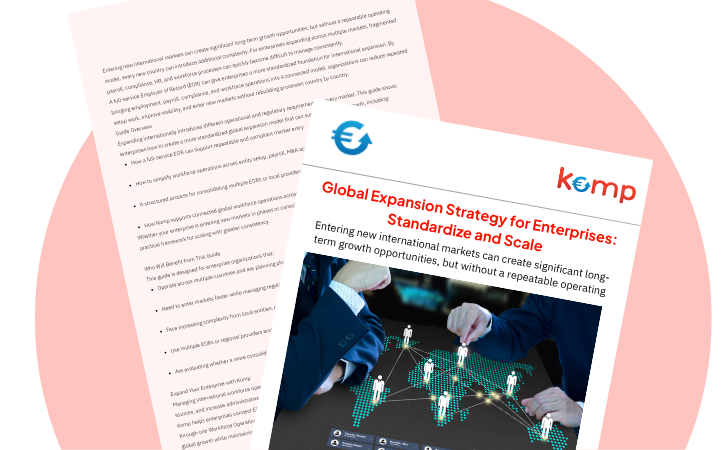
Global expansion allows startups to build teams around business requirements rather than geographic limitations. A company can access technical talent in one market, establish sales coverage in another, and hire local professionals who understand the customers, language, and commercial environment of a new region.
However, international growth should be approached as a structured business decision rather than a series of isolated hires. Every new country introduces operational responsibilities that must be incorporated into the startup’s broader workforce model.
How UK Startups Can Expand Globally
1. Define the Purpose of Expansion
Clarify whether expansion is intended to access advanced talent, enter new markets, increase delivery capacity, support customers, or improve time-zone coverage. Clear objectives help determine the right countries, roles, and workforce models.
2. Evaluate Potential Markets
Assess talent availability, salary levels, language skills, time zones, infrastructure, regulations, payroll requirements, taxes, and market potential. The best market should offer both strategic value and operational feasibility.
3. Select the Right Workforce Model
Choose between independent contractors, an Employer of Record, or direct employment through a local entity. The decision should reflect the role, working relationship, expansion stage, workforce size, cost, and local requirements.
4. Begin With a Controlled Market Entry
Start with a small team, contractor engagement, or limited EOR hiring before making a larger commitment. This allows the business to test talent availability, market demand, and operating costs.
5. Understand Local Employment Requirements
Review local rules covering contracts, working hours, leave, benefits, termination, tax, payroll, and employee documentation before hiring. UK employment practices cannot be applied uniformly across every country.
6. Build a Global Compensation Approach
Create a consistent compensation philosophy supported by country-specific salary ranges, benefits, and total employment costs. This helps balance local competitiveness with internal fairness and financial sustainability.
7. Create Reliable Cross-Border Payroll Processes
Coordinate payroll calculations, taxes, statutory contributions, benefits, approvals, payments, and reporting across countries. A connected payroll model improves local accuracy and central visibility.
8. Standardize International Onboarding
Use a common onboarding framework for contracts, payroll details, policies, access, documentation, and role expectations, while adapting the process to local country requirements.
9. Manage Distributed Teams Intentionally
Set clear expectations around communication, decision-making, meetings, working hours, performance, and collaboration. Distributed workers should receive equal access to information, feedback, and development opportunities.
10. Connect Workforce Data Across Countries
Centralize worker records, employment models, compensation, payroll status, documents, approvals, and country information. This gives leaders a clearer view of headcount, costs, and workforce risks.
11. Use Automation and AI With Human Oversight
Use automation and AI to support data checks, workflow routing, payroll validation, reminders, reporting, and risk identification. Critical employment and compliance decisions should remain under authorised human review.
12. Review When a Local Entity Is Needed
Reassess the workforce model as the business grows. A local entity may become appropriate when the startup builds a permanent presence, hires at scale, signs local contracts, or requires greater operational control.
Common Global Expansion Mistakes
- Expanding Without a Defined Business Objective: Hiring in another country without a clear capability, customer, or growth requirement can create operational complexity without producing meaningful business value.
- Choosing Markets Based Only on Labor Cost: Salary differences matter, but they should be assessed alongside skills, productivity, infrastructure, employment costs, time zones, and long-term business relevance.
- Misclassifying Employees as Contractors: Contractor arrangements should reflect genuine independence. Using contractors primarily to avoid employment responsibilities can create financial, legal, and workforce risks.
- Applying UK Employment Practices Everywhere: Contracts, benefits, leave, termination rules, and payroll obligations vary across countries. Domestic processes need to be adapted to the applicable local environment.
- Creating Separate Processes for Every Country: Excessive localization can produce a fragmented operating model. Startups should standardize core workflows while applying country-specific requirements where necessary.
- Losing Visibility into Workforce Costs: Salary is only one part of international workforce cost. Employers should also account for statutory contributions, benefits, provider fees, taxes, currency changes, and operational administration.
- Scaling Hiring Before Building Governance: Rapid international hiring without clear approvals, records, ownership, and workforce policies can create problems that become harder to correct as the company grows.
How Komp Supports Global Expansion for UK Startups
We provide the connected workforce infrastructure startups need to hire, manage, pay, and govern international teams through one AI-powered Workforce Operating System.
With us, UK startups can access workforce support across more than 150 countries and coordinate different engagement models, including direct employees, Employer of Record workers, independent contractors, Agent of Record programs, and global payroll.
We centralize workforce data so founders, HR, finance, payroll, and compliance teams can maintain greater visibility across worker locations, employment status, compensation, documentation, costs, and required actions.
Structured workflows help companies manage onboarding, contracts, payroll inputs, approvals, workforce changes, and offboarding more consistently. AI continuously reviews workforce information, identifies exceptions, and recommends next steps, while authorized teams retain control over critical decisions.
By connecting local workforce execution with central visibility and governance, we help startups enter markets more efficiently without creating a separate operating structure for every country.




.png)







































.png)