Guide

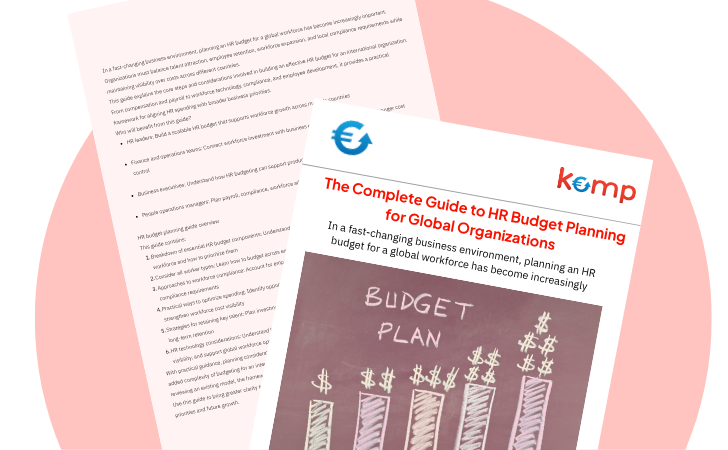
The Complete Guide to HR Budget Planning for Global Organizations

In a fast-changing business environment, planning an HR budget for a global workforce has become increasingly important. Organizations must balance talent attraction, employee retention, workforce expansion, and local compliance requirements while maintaining visibility over costs across different countries.

This guide explains the core steps and considerations involved in building an effective HR budget for an international organization. From compensation and payroll to workforce technology, compliance, and employee development, it provides a practical framework for aligning HR spending with broader business priorities.

Who will benefit from this guide?

  • HR leaders: Build a scalable HR budget that supports workforce growth across multiple countries
  • Finance and operations teams: Connect workforce investment with business expansion while maintaining stronger cost control
  • Business executives: Understand how HR budgeting can support productivity, retention, and long-term workforce strategy
  • People operations managers: Plan payroll, compliance, workforce administration, and related HR costs more effectively

HR budget planning guide overview

This guide contains:

  1. Breakdown of essential HR budget components: Understand the main areas of spending involved in supporting a global workforce and how to prioritize them  
  1. Consider all worker types: Learn how to budget across employees, contractors, freelancers, and contingent workforce models  
  1. Approaches to workforce compliance: Account for employment regulations, classification considerations, and country-specific compliance requirements  
  1. Practical ways to optimize spending: Identify opportunities to consolidate technology, improve payroll processes, and strengthen workforce cost visibility  
  1. Strategies for retaining key talent: Plan investments in learning, development, engagement, and other initiatives that support long-term retention  
  1. HR technology considerations: Understand how connected workforce platforms can reduce manual processes, improve visibility, and support global workforce operations  

With practical guidance, planning considerations, and a structured HR budget checklist, this guide helps organizations address the added complexity of budgeting for an international workforce. Whether you are building a global HR budget for the first time or reviewing an existing model, the framework can help make planning more structured and sustainable.

Use this guide to bring greater clarity to global HR budgeting and develop a workforce investment plan that supports both current priorities and future growth.

FAQs

An HR budget commonly includes:

  • Salaries and benefits: Employee compensation and benefits-related costs.
  • Recruitment costs: Job advertising, recruitment partners, hiring, and onboarding expenses.
  • Training and development: Employee learning, skills development, and career programs.
  • HR technology: HRIS, payroll, workforce management, and related technology costs.
  • Compliance and legal costs: Spending associated with employment compliance and legal support.
  • Employee engagement: Wellbeing, recognition, engagement, and related workforce initiatives.

Common HR budgeting approaches include:

  • Zero-based budgeting: Rebuild the budget each planning cycle and justify individual expenses.
  • Incremental budgeting: Use the previous budget as a baseline and adjust for expected changes.
  • Activity-based budgeting: Allocate spending according to specific HR activities such as hiring or development.
  • Flexible budgeting: Adjust spending as workforce size, costs, or economic conditions change.
  • Strategic budgeting: Link HR investment directly to longer-term priorities such as expansion, capability building, and retention.

To prepare an HR budget:

  • Assess workforce requirements: Review expected hiring, headcount growth, skills needs, and development priorities.
  • Estimate workforce costs: Calculate compensation, benefits, recruitment, training, payroll, and compliance spending.
  • Include technology investment: Account for HR platforms, payroll systems, automation, and related tools.
  • Plan for unexpected costs: Maintain flexibility for turnover, regulatory changes, or other unforeseen workforce expenses.
  • Connect spending with business priorities: Ensure planned HR investment supports the organization’s wider objectives.
  • Review previous spending: Use historical workforce costs and actual expenditure to improve future forecasts.

HR budget vs actual compares planned HR expenditure with what the organization spends during a particular period. Reviewing the difference can highlight overspending, underspending, or changing workforce requirements and help HR and Finance adjust future budgets more accurately.

Employee turnover affects HR budgets because replacing workers can create additional recruitment, onboarding, training, and productivity-related costs.

Monitoring turnover allows HR teams to anticipate replacement hiring, plan retention initiatives, and understand where additional workforce investment may be needed to maintain stability.

To calculate HR expenses:

  • Calculate direct costs: Include HR team compensation, recruitment expenses, employee benefits, and other direct workforce administration costs.
  • Consider indirect costs: Account for turnover, training, compliance management, and related operational expenses.
  • Include technology spending: Add HRIS, payroll, workforce management, and other technology costs.
  • Add workforce development costs: Include training, professional development, and career-related programs.

There is no single HR budget per employee that applies consistently across organizations. The amount can vary significantly depending on industry, company size, geography, workforce structure, benefits strategy, technology environment, and the scope of services managed by HR.

Global organizations may also face additional expenses related to international payroll, employment administration, compliance, multiple workforce models, and country-specific requirements.

HR cost per employee can include recruitment, payroll administration, benefits management, training, compliance, HR technology, and the internal resources required to support workforce operations.

The final amount varies considerably based on workforce size, business model, geography, level of automation, and which HR functions are managed internally or through external providers.

There is no universal percentage of revenue that every organization should allocate to HR. Appropriate spending depends on factors such as company size, industry, growth stage, workforce model, hiring plans, geographic footprint, and the level of HR support required.

Organizations operating internationally may need to account for additional payroll, compliance, employment, technology, and workforce administration costs when setting their budgets.

HR teams can manage expenses more effectively by:

  • Automating repetitive processes: Use workforce technology to reduce manual payroll, reporting, and administrative work.
  • Evaluating external support where appropriate: Use specialist providers for activities that would otherwise create significant internal overhead.
  • Improving workforce planning: Align hiring decisions with business demand and reduce unnecessary recruitment or turnover costs.
  • Developing existing employees: Build broader internal capabilities through cross-skilling and workforce development.
  • Using workforce data more effectively: Connect HR, payroll, compliance, and workforce information to identify inefficiencies and improve spending decisions.

Komp can support this approach by connecting payroll, EOR, contractor management, workforce information, compliance workflows, and AI-assisted workforce intelligence within a more unified global workforce operating environment.

Your Details

Realted Resources

Left-pointing arrow icon.
Right-pointing arrow icon.