Healthcare operations are becoming increasingly distributed.
Teams work across countries and time zones, remote and hybrid roles are common, and digital healthcare systems support everything from patient information to day-to-day collaboration.
As healthcare organizations expand, managing workforce devices becomes harder. HR coordinates hires across locations. IT manages device security and access. Procurement works with suppliers across different markets, while compliance teams oversee privacy and regulatory obligations.
Every device needs to reach the right worker on time, meet security requirements from initial use, remain visible throughout its lifecycle, and be securely recovered or retired when no longer required.
Without clearly connected processes, gaps can quickly emerge.
Equipment delays can prevent employees from starting effectively. Devices may miss important updates. Access can remain active after someone leaves. Assets become difficult to locate, and operating costs increase. In healthcare environments, these weaknesses can affect operational continuity and increase risks around sensitive information.
This is why structured device lifecycle management matters for global healthcare organizations.
Why Lifecycle Device Management Is Critical in Healthcare
Healthcare organizations operate within demanding security, privacy, and regulatory environments. Workforce devices may provide access to sensitive information, healthcare applications, internal systems, and operational resources where disruption can have serious consequences.
Security requirements therefore need to remain consistent, permissions must be managed carefully, and records should remain accurate and audit-ready. When lifecycle processes become fragmented, several problems can emerge:
- Equipment delays can disrupt workforce readiness
- Inconsistent updates can increase security exposure
- Incomplete offboarding can leave unnecessary access active
- Fragmented records can complicate compliance reviews
A structured device lifecycle approach helps reduce these gaps. It strengthens visibility, supports governance, and helps distributed healthcare teams operate more consistently.
What Lifecycle Device Management Means in Healthcare
Device lifecycle management covers every stage of workforce equipment management, from planning and procurement through deployment, maintenance, recovery, and retirement. In healthcare organizations, devices such as laptops and tablets may provide access to sensitive systems and information required for everyday operations.
For global healthcare companies, these processes become more complicated. Equipment moves across borders, employees work from different locations, and privacy and security requirements can vary between jurisdictions.
When responsibilities are fragmented, operational problems follow. HR may lack visibility into whether equipment will arrive before a new hire starts. IT may not have an accurate record of device locations. Procurement teams may encounter supplier or shipping delays that affect workforce readiness.
A structured lifecycle approach establishes clear processes for each stage:
- Determine equipment requirements by role and location
- Source devices through approved procurement processes
- Prepare and deploy secure, workforce-ready equipment
- Maintain devices through appropriate updates and controls
- Recover company assets when workers leave
- Retire equipment using defined data-removal procedures
When these processes are repeatable and clearly owned, teams can operate more efficiently while improving device accountability and compliance readiness.
Why HR and IT Must Work Together
Device lifecycle management extends beyond the IT function. It directly connects with workforce onboarding, employee changes, offboarding, and compliance.
Different teams contribute at different stages:
- HR manages workforce start dates, changes, and departures
- IT manages device security and system access
- Procurement coordinates suppliers, inventory, and costs
- Compliance oversees relevant policies and regulatory requirements
When these functions operate independently, gaps can develop.
A new employee might begin work before receiving the correct equipment. IT may receive delayed notification of a departure. System permissions might remain active unnecessarily, or devices may not be recovered promptly.
Connected workflows help prevent these issues. New hires should initiate appropriate device preparation. Departures should initiate asset recovery and access-removal processes. Relevant device and workforce information should remain visible to responsible teams.
Stronger HR and IT coordination can improve onboarding, reinforce governance, and reduce operational risk.
The Hidden Costs of Weak Lifecycle Management
Poor device lifecycle processes create costs that are not always immediately visible.
Manual asset registers can become inaccurate. Spreadsheets may not reflect current device status. Equipment can be misplaced, while procurement and international shipping delays can disrupt workforce operations.
These issues affect multiple areas of the organization:
- Employee onboarding becomes slower
- Workforce productivity can decline
- Technology costs become harder to forecast
- Compliance reviews require more manual effort
Security exposure can also increase. Healthcare organizations manage sensitive information, making secure device handling particularly important. Lost equipment or improperly retired devices can create unnecessary data-security risks.
Fragmented information also limits decision-making. Without reliable asset records, leaders have less visibility into utilization, costs, recovery, and replacement requirements.
A consistent lifecycle framework provides better oversight, reduces unnecessary waste, and supports more informed technology decisions.
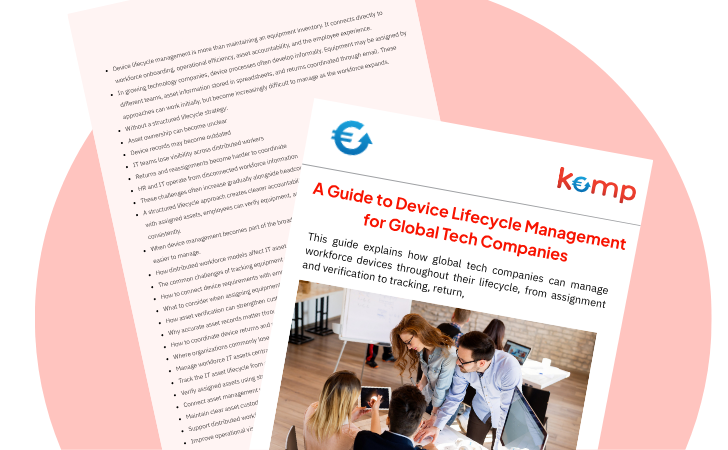
What’s Inside This Guide
This guide provides a practical framework for managing workforce devices across global healthcare organizations.
Inside, you’ll learn how to:
- Create scalable device lifecycle processes across countries
- Establish clear ownership throughout the device journey
- Connect HR and IT workflows more effectively
- Strengthen asset visibility and accountability
- Reduce security and compliance gaps
- Maintain clearer documentation for compliance reviews
- Support international workforce growth without unnecessary operational fragmentation
Whether you are expanding into new markets or improving distributed workforce operations, this guide helps establish a more consistent approach to device lifecycle management.
What Strong Lifecycle Device Management Looks Like
Healthcare organizations need device processes that remain consistent throughout the complete lifecycle rather than relying on informal or reactive workflows.
Organizations should define equipment requirements by role, establish appropriate procurement processes, securely prepare devices, and maintain visibility throughout their active use.
Offboarding should initiate timely asset recovery and access-related actions. Device retirement should follow established security and data-handling procedures.
When these practices operate consistently, healthcare organizations can achieve:
- Greater visibility across workforce assets
- Stronger compliance and governance readiness
- Reduced operational and security risk
- More predictable device-related costs
- Fewer workforce disruptions caused by equipment issues
Strengthen Connected Workforce Operations with Komp
Managing workforce operations across global healthcare teams requires coordination between HR, IT, procurement, and compliance while maintaining appropriate governance over sensitive workforce information.
Komp provides a connected workforce environment that helps organizations maintain clearer visibility across worker lifecycle events, documentation, compliance processes, and operational responsibilities.
With Komp, organizations can:
Maintain centralized workforce and lifecycle information
- Improve visibility across onboarding and offboarding requirements
- Connect workforce changes with defined operational actions
- Strengthen documentation and accountability across global teams
- Support more consistent governance across countries and worker types
- Reduce reliance on fragmented workforce processes
Rather than managing workforce lifecycle information through disconnected systems and manual workflows, teams can establish a more coordinated operating model designed for international scale.
If your healthcare organization is expanding internationally, strengthening the connection between workforce lifecycle processes, compliance, and operational governance becomes increasingly important.
And when you’re ready to explore how connected workforce operations can support your global teams, Book a Komp demo.




.png)




































.png)