Guide

How to Hire and Manage US Employees as a UK Business

What the guide covers

  • Understanding US employment compliance: How federal, state, and local rules interact, and what this means for payroll, benefits, workforce administration, and employer responsibilities
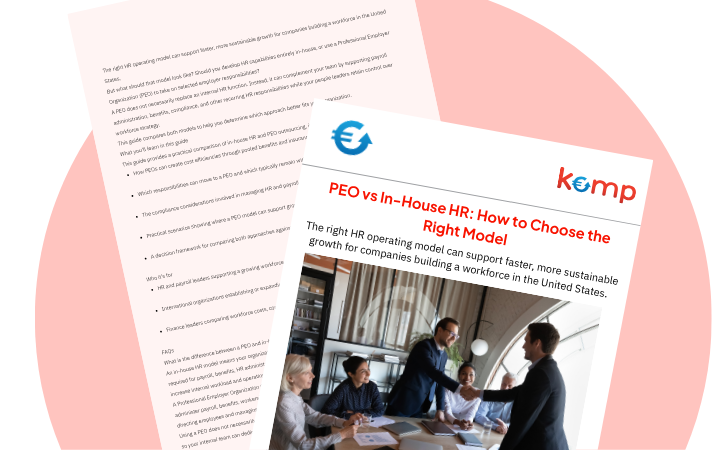
  • How a PEO can support US expansion: How co-employment works, which responsibilities a PEO can manage, and which decisions remain with your company
  • When to choose PEO vs other hiring models: A practical comparison of PEO, EOR, direct entity setup, and contractors based on your expansion needs
  • How Komp supports UK to US workforce operations: Explore how Komp connects payroll, compliance, workforce data, EOR, contractor management, and employment processes within a broader global workforce operating environment

Expanding a UK business into the United States can create significant growth opportunities. But hiring even a small US team introduces payroll, HR, tax, benefits, and employment requirements that can be very different from those in the UK.

US employment obligations can vary across federal, state, and local levels. Hiring in a new state may introduce additional payroll registrations, insurance requirements, wage rules, and employee protections that need to be managed correctly.

For many UK companies, this makes choosing the right employment structure just as important as finding the right talent. A PEO can provide one option when a US entity already exists.

This guide explains the fundamentals of US employment compliance, how a PEO can support payroll and HR administration, and how UK companies can evaluate the right model for managing employees in the United States.

What is a PEO?

PEO stands for Professional Employer Organization. A PEO is a third-party provider that supports employers with functions such as payroll administration, employment tax processing, benefits, HR administration, workers’ compensation, and certain compliance responsibilities for US employees.

Professional employer organizations can support both US and international businesses that already have the appropriate US entity and want additional infrastructure for managing employees across different states.

The guide explains how the co-employment relationship works and where a PEO can fit within your wider US workforce strategy.

How Komp helps UK companies hire in the US

Komp helps organizations manage international workforce operations through connected capabilities spanning global payroll, EOR, contractor management, compliance, and workforce information.

For UK companies expanding into the US, Komp can help create greater visibility across employee records, payroll processes, documentation, worker structures, and compliance workflows as operations become more complex.

Where an organization already has the required US entity, its PEO strategy can be evaluated alongside existing HR and payroll processes. Where an entity is not in place, an EOR may provide an alternative route for employing US talent without establishing a local employing entity first.

By bringing workforce information and operational processes into a more connected environment, Komp helps organizations coordinate UK, US, and wider international workforce requirements without relying on disconnected systems for every market.

This supports a broader global workforce strategy across employees, contractors, payroll, EOR arrangements, and compliance governance.

FAQs

Generally, yes. A PEO model is designed for businesses that already have a US legal entity and want support with payroll, HR administration, benefits, and certain employment compliance responsibilities. If you do not have a US entity, an Employer of Record (EOR) may be a more appropriate option for employing US workers.

The UK largely operates under a national employment framework, while US employment obligations can exist across federal, state, and local levels.

This means hiring an employee in a new US state can introduce additional requirements involving payroll registration, unemployment insurance, workers’ compensation, wage and overtime rules, leave entitlements, and other state-specific employment obligations. Companies expanding from the UK therefore need processes capable of managing variation across locations.

A PEO commonly supports payroll administration, federal and state employment tax processing, benefits administration where included, workers’ compensation, unemployment-related processes, HR administration, and certain compliance activities.

Your business continues to control hiring decisions, employee responsibilities, performance, workplace culture, and day-to-day management. The exact allocation of responsibilities should be documented within the agreement between your company and the PEO.

US employers must account for applicable statutory requirements such as Social Security and Medicare contributions, unemployment insurance, workers’ compensation, and certain leave or healthcare obligations depending on employer size and location.

Employees may also expect additional benefits such as paid time off, paid sick leave, 401(k) retirement plans, medical coverage, dental and vision insurance, disability coverage, and life insurance. Requirements and market expectations can differ significantly between states and workforce segments.

The right model depends on your legal structure, hiring plans, expansion timeline, workforce type, and internal HR capabilities. As a general guide:

  • PEO: You already have a US entity and want support scaling payroll, benefits, HR administration, and compliance
  • EOR: You do not have a US employing entity and want to hire employees without establishing one first
  • Direct setup: You want direct ownership of employment infrastructure and have sufficient HR, payroll, legal, and compliance resources
  • Contractors: Appropriate for genuinely independent project-based or specialist work where the engagement meets applicable classification requirements

Your Details

Realted Resources

Left-pointing arrow icon.
Right-pointing arrow icon.