Guide

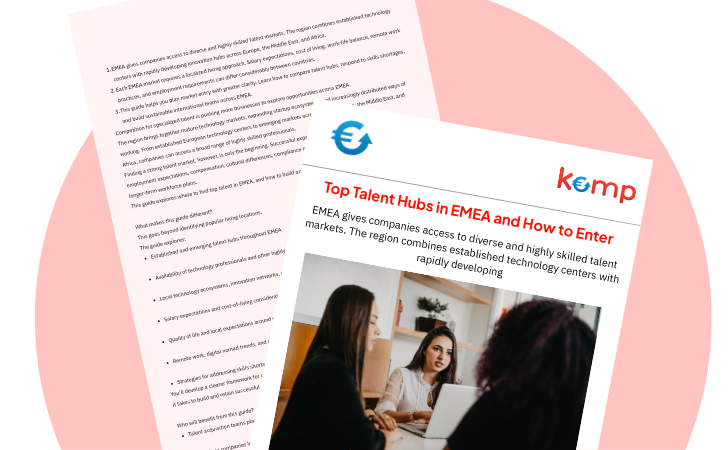
How to Find Global Talent: Strategies and Talent Hubs

Key Takeaways

  1. Global talent is widely available, but skills are concentrated differently across markets. Understanding where specific capabilities are strongest helps organizations make better hiring decisions.  
  1. Effective global talent acquisition relies on market intelligence. This guide explains how organizations can compare talent hubs, workforce availability, compensation, and hiring conditions before entering a new market.  
  1. Flexible workforce models can accelerate access to international talent. Employer of Record (EOR), contractor, and mobility strategies can help organizations build distributed teams without unnecessary expansion complexity.  

As competition for specialized skills increases, organizations are expanding their search beyond domestic labor markets.

However, finding global talent requires more than sourcing candidates internationally. Business leaders need to understand talent availability, workforce costs, local hiring conditions, and long-term organizational needs while creating an experience that attracts and retains distributed employees.

This guide helps organizations move from ad-hoc international recruitment toward a more structured global talent strategy, providing a practical framework for identifying the right markets and building sustainable global teams.

What Makes This Guide Different?

This is not simply a directory of countries or recruiting channels.

The guide focuses on how organizations identify and access global talent strategically, including:

  • Identifying established and emerging global talent hubs
  • Using workforce and market data to compare talent availability
  • Balancing domestic hiring with international workforce strategies
  • Building recruiting processes that work across distributed teams
  • Understanding how EOR and global mobility can support international hiring
  • Attracting and retaining skilled professionals through flexibility, employee experience, and work-life balance

You’ll also learn how organizations can use different global workforce models to access talent faster while maintaining appropriate compliance and workforce governance.

Who Will Benefit from This Guide?

  • Business leaders developing long-term international workforce strategies
  • Talent acquisition teams building global candidate pipelines
  • HR leaders responsible for cross-border hiring and distributed teams
  • Companies looking beyond domestic markets for specialized talent
  • Organizations evaluating EOR, contractor, or global mobility models
  • Teams building high-performing international and remote workforces

What’s Inside?

  • A framework for identifying and comparing global talent hubs
  • Insights into international talent availability and labor-market dynamics
  • Data-informed approaches to global talent acquisition
  • Guidance on cross-border hiring and distributed workforce design
  • Best practices for attracting and retaining skilled international professionals
  • Examples of how organizations structure high-performing global teams

FAQs

Yes. The framework can be used by startups, scale-ups, and enterprise organizations building or expanding international teams.

Yes. It explains how Employer of Record models can help organizations employ workers in countries where they do not have their own local entity, reducing some of the operational barriers to international hiring.

It is designed primarily for long-term workforce planning and sustainable global team development rather than one-off international hiring.

The guide focuses on a consistent framework for evaluating talent hubs rather than simply ranking countries. It helps organizations compare markets based on factors such as skills availability, workforce costs, hiring conditions, and long-term suitability.

Yes. The guide considers how flexibility, distributed work models, employee experience, and work-life balance can influence an organization’s ability to attract and retain international talent.

Your Details

Realted Resources

Left-pointing arrow icon.
Right-pointing arrow icon.