Guide

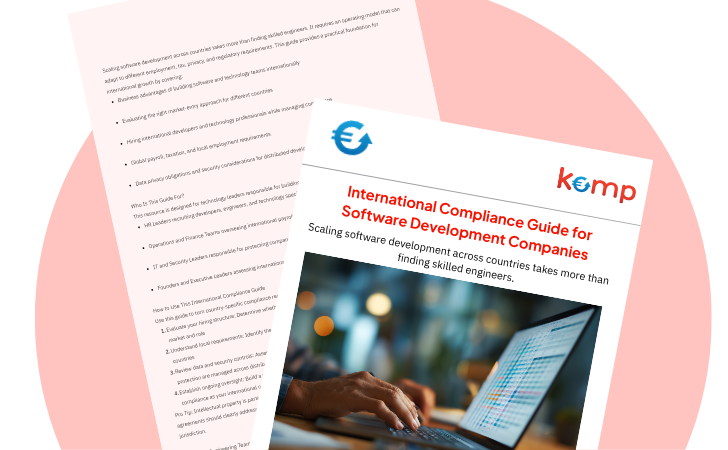
International Compliance Guide for Software Development Companies

Guide Overview

Scaling software development across countries takes more than finding skilled engineers. It requires an operating model that can adapt to different employment, tax, privacy, and regulatory requirements. This guide provides a practical foundation for international growth by covering:

  • Business advantages of building software and technology teams internationally
  • Evaluating the right market-entry approach for different countries
  • Hiring international developers and technology professionals while managing compliance
  • Global payroll, taxation, and local employment requirements
  • Data privacy obligations and security considerations for distributed development teams

Who Is This Guide For?

This resource is designed for technology leaders responsible for building and managing international operations:

  • HR Leaders recruiting developers, engineers, and technology specialists across different countries
  • Operations and Finance Teams overseeing international payroll, workforce costs, and tax requirements
  • IT and Security Leaders responsible for protecting company data, systems, and intellectual property across distributed teams
  • Founders and Executive Leaders assessing international markets for new engineering and development capabilities

Who Will Benefit from This Guide

This guide is designed for UK organizations looking for more sustainable workforce solutions:

  • HR Leaders recruiting developers, engineers, and technology specialists across different countries
  • Operations and Finance Teams overseeing international payroll, workforce costs, and tax requirements
  • IT and Security Leaders responsible for protecting company data, systems, and intellectual property across distributed teams
  • Founders and Executive Leaders assessing international markets for new engineering and development capabilities

How to Use This International Compliance Guide

Use this guide to turn country-specific compliance requirements into a structured approach to global workforce expansion:

  1. Evaluate your hiring structure: Determine whether an EOR, independent contractor arrangement, or local entity best fits each market and role  
  1. Understand local requirements: Identify the employment law, payroll, tax, and workforce obligations that apply in your target countries  
  1. Review data and security controls: Assess how employee access, sensitive information, intellectual property, and data protection are managed across distributed teams  
  1. Establish ongoing oversight: Build a process for monitoring workforce documentation, regulatory requirements, and compliance as your international operations evolve  

Pro Tip: Intellectual property is particularly important when building distributed software teams. Employment and contractor agreements should clearly address IP ownership and assignment in accordance with the requirements of the worker’s jurisdiction.

Scale Your Engineering Team with Confidence

From global payroll and employment requirements to data protection and workforce compliance, this guide helps software companies build international teams with greater clarity and control.

FAQs

International compliance means meeting the applicable legal, employment, tax, privacy, and regulatory requirements in every country where a software company operates or engages workers.

For software businesses, this can include local employment laws, payroll and tax obligations, worker classification, intellectual property protection, and data privacy requirements such as GDPR. A structured compliance approach helps organizations identify and manage these obligations as their international workforce grows.

Hiring developers across different jurisdictions can introduce additional requirements around how employee, customer, and company information is accessed, processed, transferred, and protected.

Organizations should understand the privacy requirements that apply in each relevant jurisdiction and maintain appropriate information security controls. Frameworks such as ISO/IEC 27001 can also support a structured approach to managing information security risks across distributed operations.

Classification requirements vary across countries, and describing someone as an independent contractor does not necessarily determine their legal status.

If the actual working relationship resembles employment under local law, the company may face liabilities involving unpaid taxes, statutory benefits, social contributions, penalties, or employment claims.

An Employer of Record can provide an alternative when a developer needs to be employed locally, but the company does not have its own legal entity in that country.

Komp helps organizations manage international workforce operations through a connected environment spanning EOR, contractor management, global payroll, workforce compliance, documentation, and employee lifecycle processes.

By bringing workforce information and operational workflows together, Komp helps software companies maintain greater visibility across international teams while reducing the fragmentation created by managing separate systems and providers in different markets.

Your Details

Realted Resources

Left-pointing arrow icon.
Right-pointing arrow icon.