Guide

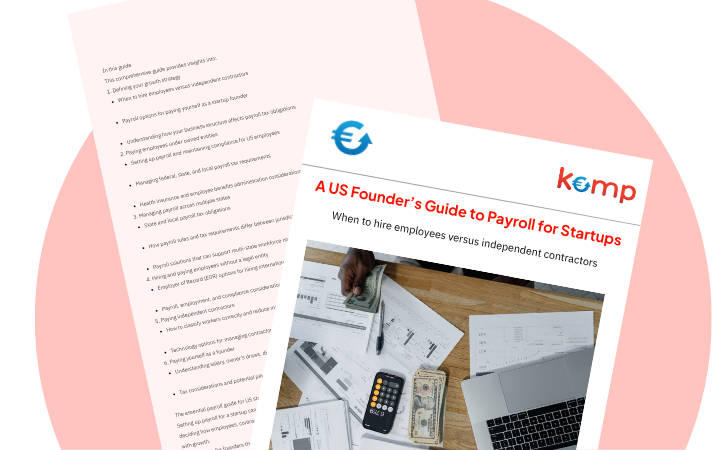
A US Founder’s Guide to Payroll for Startups

In this guide

This comprehensive guide provides insights into:

1. Defining your growth strategy

  • When to hire employees versus independent contractors
  • Payroll options for paying yourself as a startup founder
  • Understanding how your business structure affects payroll tax obligations

2. Paying employees under owned entities

  • Setting up payroll and maintaining compliance for US employees
  • Managing federal, state, and local payroll tax requirements
  • Health insurance and employee benefits administration considerations

3. Managing payroll across multiple states

  • State and local payroll tax obligations
  • How payroll rules and tax requirements differ between jurisdictions
  • Payroll solutions that can support multi-state workforce management

4. Hiring and paying employees without a legal entity

  • Employer of Record (EOR) options for hiring internationally
  • Payroll, employment, and compliance considerations when entering new markets

5. Paying independent contractors

  • How to classify workers correctly and reduce misclassification risk
  • Technology options for managing contractor payments and workforce information

6. Paying yourself as a founder

  • Understanding salary, owner’s draws, distributions, and equity compensation
  • Tax considerations and potential payroll obligations for founders

The essential payroll guide for US startup founders

Setting up payroll for a startup can quickly become complicated. From navigating federal, state, and local tax requirements to deciding how employees, contractors, and founders should be paid, early-stage businesses need payroll processes that can scale with growth.

This guide walks founders through the key payroll decisions, compliance considerations, and workforce structures that growing US startups should understand.

Why payroll matters for startups

Managing payroll correctly is essential to:

  • Pay your workforce accurately and on time - across full-time, part-time, and contractor arrangements
  • Maintain tax compliance - including applicable federal, state, and local payroll obligations
  • Support talent attraction and retention - through structured compensation and employee benefits
  • Build scalable payroll processes - using technology that can support workforce growth and increasing complexity

Simplify payroll with Komp

A connected workforce platform like Komp can help startups coordinate payroll with broader workforce operations as the business grows. With Komp, organizations can:

  • Manage payroll alongside employees, contractors, and EOR workforce arrangements
  • Connect payroll information with workforce records and compliance workflows
  • Coordinate global payroll as teams expand across jurisdictions
  • Maintain greater visibility across workforce documentation and employment structures
  • Scale payroll within a broader Workforce Operating System instead of relying on disconnected tools

FAQs

To set up payroll for your startup, you generally need to:

  1. Obtain an Employer Identification Number (EIN) from the IRS.
  2. Complete applicable state and local payroll tax registrations.
  3. Determine whether workers should be classified as employees or independent contractors.
  4. Select a payroll process or system for calculating wages, deductions, withholding, and payments.
  5. Maintain compliance with applicable federal, state, and local payroll requirements.

Komp can help connect payroll with workforce information, employment structures, documentation, and compliance processes as startup operations become more complex.

Small business owners may manage payroll through:

  • Manual wage and payroll tax calculations
  • Payroll software that automates recurring payroll activities
  • Outsourced payroll services for additional operational and compliance support

As workforce size and geographic coverage increase, connected payroll technology can help reduce manual administration and improve visibility across payroll processes.

The right payroll platform depends on your workforce structure, locations, growth plans, and operational needs. Important capabilities can include:

  • Support for federal, state, and local payroll tax processes
  • Payroll options for different workforce types
  • Time, payroll, and workforce data management
  • Benefits and employee administration capabilities

For growing businesses, it is also important to consider whether the platform can support future international hiring and broader workforce operations.

It is possible to manage payroll manually, particularly for a very small team, but this approach can require significant time and increase the likelihood of calculation or filing errors. Basic or free payroll tools may also have limitations around:

  • Automated tax calculations
  • Payroll reporting and filings
  • Compliance monitoring

As the business grows, founders should evaluate whether manual payroll remains practical or whether a more structured payroll system is required.

Payroll treatment for an LLC depends on how the business is structured and taxed:

  • Single-member LLCs: Owners commonly take draws rather than receiving wages as employees.
  • Multi-member LLCs: Members generally receive distributions rather than standard employee wages.
  • LLCs taxed as corporations: Employee-owners may receive wages through payroll, with applicable payroll taxes.

Because tax treatment can vary, founders should confirm the correct approach with an appropriate tax or accounting professional.

Komp supports growing organizations through connected global payroll and workforce operations.

  • Connected payroll and workforce management: Bring payroll together with employee, contractor, EOR, and workforce information within a broader operating environment.
  • Designed to support growth: Start with current payroll needs while maintaining infrastructure that can support more complex workforce structures over time.
  • Global workforce capabilities: Coordinate payroll and employment operations as teams expand into additional countries and worker models.
  • Compliance-connected workflows: Link payroll information with workforce documentation, compliance processes, and employment requirements.
  • Greater workforce visibility: Keep payroll connected to broader workforce data instead of operating through isolated systems.
  • Support for multiple worker models: Coordinate employees, contractors, and EOR arrangements within a more unified workforce strategy.
  • AI-assisted workforce intelligence: Surface relevant workforce and compliance information for review while keeping business-critical decisions under human control.

Your Details

Realted Resources

Left-pointing arrow icon.
Right-pointing arrow icon.