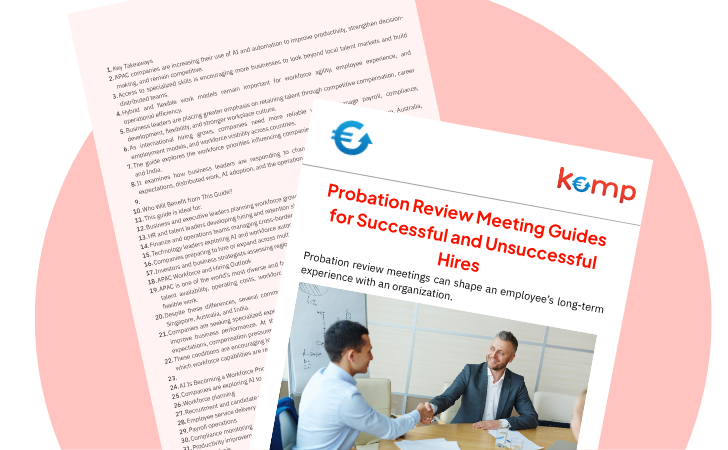
Probation Review Meeting Guides for Successful and Unsuccessful Hires
Probation Review Meeting Guides Overview
Probation review meetings can shape an employee’s long-term experience with an organization. They also require managers to communicate performance decisions clearly, fairly, and respectfully - particularly when expectations have not been met.
Our probation review meeting guide bundle gives managers and HR teams a structured framework for preparing, conducting, and documenting end-of-probation conversations across different outcomes.
This guide bundle includes:
Successful Probation Review Guide: Recognize the employee's progress, review achievements, confirm successful completion, and discuss future goals and development opportunities.
Probation Extension Meeting Guide: Address performance gaps constructively, explain why additional review time is required, and establish measurable expectations for the extended period.
Unsuccessful Probation and Termination Guide: Communicate the decision clearly and respectfully while outlining the employment end date, notice requirements, administrative steps, and available support.
Outcome-Specific Meeting Agendas: Follow a clear conversation structure tailored to each possible probation outcome.
Manager Preparation Guidance: Help managers enter each meeting with the relevant evidence, documentation, policy guidance, and discussion points.
Suggested Questions and Talking Points: Encourage balanced conversations that allow managers to provide feedback and employees to share their perspectives.
Meeting Documentation Fields: Record feedback, decisions, agreed actions, performance goals, milestones, follow-up dates, and employee comments in one place.
Next-Step Planning: Clearly define what happens after the meeting, whether that means role confirmation, an improvement period, or the completion of offboarding requirements.
How to Use These Probation Review Meeting Guides
Use the following steps to conduct probation reviews that are organized, evidence-based, respectful, and aligned with your internal policies.
1. Review the Employee’s Probation Journey
Before the meeting, review the employee’s role requirements, agreed objectives, onboarding progress, previous feedback, attendance, conduct, and documented performance.
Gather input from relevant managers or stakeholders and ensure conclusions are based on specific examples rather than general impressions.
2. Confirm the Appropriate Outcome
Determine whether the employee has:
Successfully Completed Probation
Requires an Extension and Additional Support
Not Met the Requirements for Continued Employment
Consult HR before confirming the outcome to ensure the proposed action aligns with the employment agreement, company policy, and applicable local requirements.
3. Select the Relevant Meeting Guide
Choose the guide designed for the confirmed outcome. Each agenda provides a structured sequence for opening the meeting, discussing performance, communicating the decision, hearing the employee’s perspective, and explaining next steps.
4. Prepare Clear Evidence and Examples
Support feedback with documented, role-relevant examples.
For performance concerns, explain:
What Was Expected
What Was Observed
What Feedback or Support Was Previously Provided
What Improvement Was Required
Whether the Expected Change Occurred
This helps keep the conversation objective and reduces ambiguity.
5. Conduct the Meeting Respectfully
Explain the purpose of the discussion at the beginning and communicate the outcome clearly.
Allow the employee to respond, ask questions, and share feedback about their role, onboarding experience, manager support, workload, expectations, and workplace environment.
Avoid vague language that could leave the employee uncertain about the final decision.
6. Define the Next Steps
The actions following the meeting will depend on the outcome.
For Successful Completion: Confirm the employee’s status, acknowledge their contribution, discuss development priorities, and establish goals for the next review period.
For Probation Extension: Confirm the duration of the extension, areas requiring improvement, expected standards, support available, measurement criteria, and scheduled review dates.
For Termination: Explain the final working day, applicable notice arrangements, final documentation, return of company property, access removal, final payments, and any other offboarding requirements.
7. Complete the Documentation
Record the key points discussed, feedback shared, decision communicated, employee response, and next steps.
Where required, obtain acknowledgements or signatures and store the documentation according to company policy and local data-handling requirements.
8. Schedule Follow-Up Actions
For successful employees, establish future development or performance check-ins.
For extended probation periods, schedule regular progress reviews rather than waiting until the final extension date.
For departing employees, coordinate the required HR, payroll, IT, security, benefits, and asset-return workflows.
What Makes an Effective Probation Review?
An effective probation review should be:
Evidence-Based: Decisions should reflect documented expectations, feedback, outcomes, and performance examples.
Consistent: Managers should follow a comparable review process across employees while considering individual circumstances.
Clear: The employee should understand the decision, the reasons behind it, and what happens next.
Two-Way: The discussion should allow the employee to provide context, ask questions, and share feedback.
Properly Documented: The organization should maintain an accurate record of the discussion, decision, and agreed actions.
Locally Compliant: Probation, notice, termination, documentation, and extension requirements can differ across countries and employment arrangements. HR and legal teams should confirm the applicable requirements before action is taken.
How Komp Supports Consistent Workforce Processes
We help organizations connect employee information, documentation, approvals, performance actions, and workforce transitions through one governed operating environment.
With Komp, HR teams can maintain clearer employee records, coordinate approval workflows, track key employment milestones, and connect probation outcomes with the relevant next steps - from continued employment and development planning to offboarding, final payroll, access removal, and asset recovery.
FAQs
A probation review meeting is a formal discussion between an employee and their manager to assess performance, conduct, role suitability, progress, and overall experience during the probationary period.
The meeting is also used to communicate whether the employee has successfully completed probation, requires an extension, or will not continue in the role.
A probation review should typically cover:
Role responsibilities and initial expectations
Performance against agreed objectives
Strengths and contributions
Areas requiring improvement
Feedback and support already provided
The employee’s experience and perspective
The final probation outcome
Goals, actions, timelines, or offboarding steps
The discussion should be supported by documented examples rather than relying only on general observations.
The manager should review the employee’s job description, probation objectives, performance evidence, previous feedback, attendance or conduct information where relevant, and any agreed development actions.
They should also coordinate with HR, select the correct meeting agenda, prepare the necessary documents, and confirm that the proposed outcome follows company policy and applicable employment requirements.
The three most common outcomes are:
Successful completion: The employee has met the required standards and is confirmed in the role.
Probation extension: More time is provided to demonstrate improvement against specific expectations.
Employment termination: The organization decides not to continue employment because the required standards or conditions have not been met.
Available outcomes and the process for applying them may depend on the employment contract, internal policy, and local law.
An extension may be appropriate when an employee has shown potential but has not yet demonstrated consistent performance in all required areas.
The employer should clearly explain:
Why the extension is being applied
How long it will last
What improvement is required
How progress will be measured
What support will be provided
When review meetings will take place
What may happen if expectations remain unmet
Before extending probation, the organization should confirm that the extension is permitted under the employment agreement, company policy, and applicable law.
Begin by clearly confirming that the employee has successfully completed probation.
Recognize specific achievements, discuss strengths, provide constructive feedback, and explain any administrative changes connected with confirmation. The conversation should also look forward by covering goals, development opportunities, support needs, and future performance expectations.
Communicate the decision directly but respectfully. Explain the performance expectations, provide specific examples of where those expectations were not met, reference feedback or support previously given, and clearly outline the resulting decision.
The manager should then explain the final working day, notice arrangements, return of property, final payments, documentation, and other offboarding steps.
Avoid presenting the outcome as undecided when a final decision has already been made.
An employee may be terminated during or at the end of probation where permitted, but the organization must follow the employment agreement, internal process, applicable notice requirements, and local employment law.
Probation does not automatically remove an employee’s contractual or statutory protections. HR or qualified legal counsel should review the specific circumstances before the decision is implemented.
The appropriate length depends on the country, employment agreement, company policy, industry, and complexity of the role.
Many organizations use probation periods of approximately three to six months, but permitted durations and extension rules vary by jurisdiction.
The period should be long enough to assess performance fairly and should be stated clearly in the employment documentation.
Notice requirements depend on the employment contract, company policy, length of service, and country-specific employment law.
Organizations should not assume that probation automatically allows immediate termination. The applicable terms and legal requirements should be reviewed before communicating the final date of employment.
A probation extension plan should include:
The reason for the extension
The revised end date
Specific areas requiring improvement
Measurable performance expectations
Support, coaching, or training available
Review milestones and check-in dates
The evidence that will be used to assess progress
The possible outcome if sufficient improvement is not demonstrated
The employee should leave the meeting with a clear understanding of what success looks like.
Useful tools include:
HR information systems: Maintain employee details, documents, employment milestones, and review records.
Performance management tools: Track goals, feedback, development actions, and improvement plans.
Document and note-taking tools: Record meeting outcomes, employee comments, and agreed actions.
Scheduling and video-conferencing platforms: Coordinate reviews for office-based and distributed employees.
Digital signature tools: Collect acknowledgements and signatures where appropriate.
Workflow platforms: Connect the review outcome with approvals, employee status updates, payroll changes, offboarding, IT access, and asset-return processes.
Structured templates: Provide managers with repeatable agendas, preparation checklists, question prompts, and documentation fields.




.png)

























































.png)