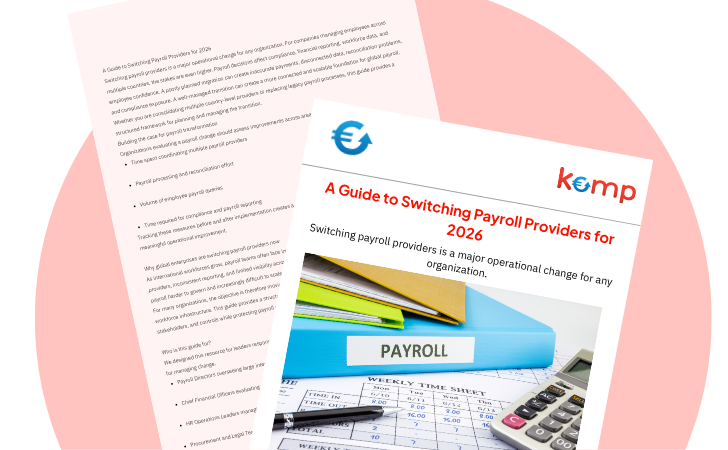
1. Recognize the hidden cost of fragmented payroll
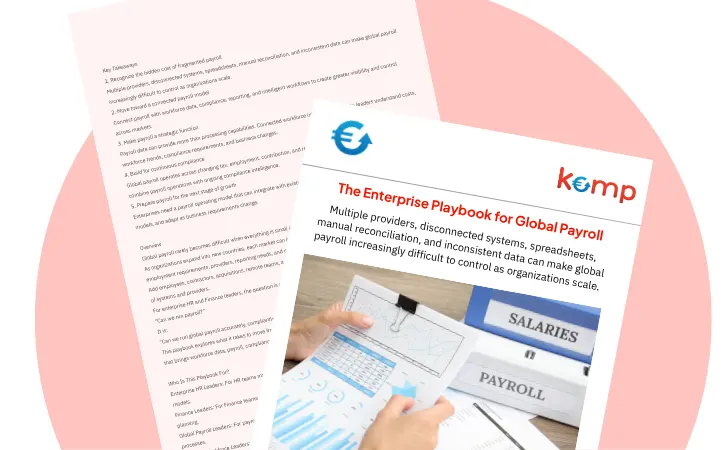
Multiple providers, disconnected systems, spreadsheets, manual reconciliation, and inconsistent data can make global payroll increasingly difficult to control as organizations scale.
2. Move toward a connected payroll model
Connect payroll with workforce data, compliance, reporting, and intelligent workflows to create greater visibility and control across markets.
3. Make payroll a strategic function
Payroll data can provide more than processing capabilities. Connected workforce information can help leaders understand costs, workforce trends, compliance requirements, and business changes.
4. Build for continuous compliance
Global payroll operates across changing tax, employment, contribution, and regulatory requirements. A modern model should combine payroll operations with ongoing compliance intelligence.
5. Prepare payroll for the next stage of growth
Enterprises need a payroll operating model that can integrate with existing technology, support new markets and workforce models, and adapt as business requirements change.
Overview
Global payroll rarely becomes difficult when everything is small and simple.
As organizations expand into new countries, each market can introduce different payroll processes, currencies, tax structures, employment requirements, providers, reporting needs, and compliance obligations.
Add employees, contractors, acquisitions, remote teams, and changing regulations, and payroll can quickly become a patchwork of systems and providers.
For enterprise HR and Finance leaders, the question is no longer simply:
“Can we run payroll?”
It is:
“Can we run global payroll accurately, compliantly, and with enough visibility to keep up with the business?”
This playbook explores what it takes to move from fragmented payroll operations toward a connected global payroll model; one that brings workforce data, payroll, compliance, and operational intelligence closer together.
Who Is This Playbook For?
Enterprise HR Leaders: For HR teams managing payroll across multiple countries, entities, workforce types, and employment models.
Finance Leaders: For Finance teams looking for greater visibility into workforce costs, payroll operations, reporting, and financial planning.
Global Payroll Leaders: For payroll professionals dealing with multiple providers, systems, currencies, regulations, and local processes.
People & Workforce Leaders: For teams looking to connect payroll information with broader workforce intelligence and business decisions.
Business & Operations Leaders: For organizations expanding into new markets and looking for a payroll model that can scale alongside the business.
What’s Inside the Playbook?
Understand how global payroll has evolved from local payroll systems and HR administration toward global payroll platforms and, ultimately, a more intelligent workforce operating layer.
The playbook’s technology evolution framework moves from:
2000s → Local Payroll Systems & Local HR Administration
2010s → Cloud HCM Platforms & Payroll Providers
2020s → Global Payroll Platforms & Specialized Systems
2030s → Intelligent Workforce Operating Layer
The emerging model connects global payroll orchestration, workforce data, continuous compliance intelligence, AI-driven workflows, predictive workforce insights, and human-governed decisions.
The Benefits of a Connected Global Payroll Model
Minimize Complexity- Bring payroll workflows closer together and reduce manual handoffs across providers, processes, currencies, systems, and compliance requirements.
Reduce Risk- Connect payroll with compliance intelligence and automated workflows to identify issues earlier and strengthen oversight across countries.
Improve Data Quality- Create greater consistency between payroll and workforce information instead of repeatedly reconciling employee records, reports, and provider data.
Faster Workforce Intelligence- Bring workforce and payroll information together to identify trends, surface exceptions, and give leaders access to relevant reporting faster.
Greater Oversight- Create a centralized view across countries, entities, worker populations, and payroll operations.
Seamless Integration- Connect payroll with the HR, Finance, workforce, benefits, and other systems organizations already use without creating another silo.
Continuous Compliance- Combine payroll operations with ongoing compliance intelligence so organizations can respond to changing regulatory requirements.
What Enterprises Should Look for in a Global Payroll Partner
As the number of countries increases, so do differences in:
Time zones
Languages
Regulations
Providers
Local processes
Enterprises need one accountable partner, clear ownership, and support that understands both the global picture and local requirements.
Whether contractor relationship, scaling an existing workforce, or managing payroll across multiple countries, the payroll partner should provide:
Consistent support | Clear communication | Local expertise | Flexibility to adapt
The playbook summarizes the goal simply: Local expertise without local complexity.
Global operations still require local expertise. Komp combines a centralized technology layer with local knowledge and human oversight to help organizations manage payroll and workforce requirements across markets.
The objective isn’t to force every enterprise into the same model.
Komp is designed to work with your operating model, not force you into a one-size-fits-all approach.
With Komp, Enterprises Can:
Connect- Connect payroll and workforce information across countries and systems.
Simplify- Simplify complex global payroll operations through centralized workflows and automation.
Strengthen- Strengthen compliance oversight with continuous visibility into changing requirements.
Understand- Understand workforce costs, trends, and exceptions through connected data and intelligent insights.
Scale- Scale into new markets and workforce models with greater speed and confidence.
FAQs
Every new country can introduce different payroll processes, currencies, tax structures, employment requirements, providers, reporting needs, and compliance obligations. Additional workforce types, acquisitions, remote teams, and regulatory changes can further increase complexity.
Fragmented payroll typically involves multiple local providers, regional platforms, spreadsheets, HR systems, Finance systems, and manual reconciliation. Each system may perform its own function effectively, but the data and workflows between them can remain disconnected.
A connected model brings payroll, workforce data, compliance, and intelligent automation closer together, giving enterprises greater visibility, control, and intelligence across their global workforce.
Not necessarily. The playbook emphasizes connecting what matters rather than replacing everything. A future-focused model should work alongside the HR, Finance, workforce, and other platforms an organization already depends on.
Payroll generates continuous workforce and cost data. Connecting that information makes it easier to identify trends, exceptions, workforce costs, hiring patterns, absence, and other operational insights.
Employment regulations, tax requirements, contribution rules, and local obligations can change as an organization expands. A modern payroll approach should therefore combine payroll operations with ongoing compliance intelligence.
Enterprises should consider global visibility, local expertise, accountability, integration capabilities, compliance support, data governance, scalability, and the ability to adapt as workforce requirements change.