Guide

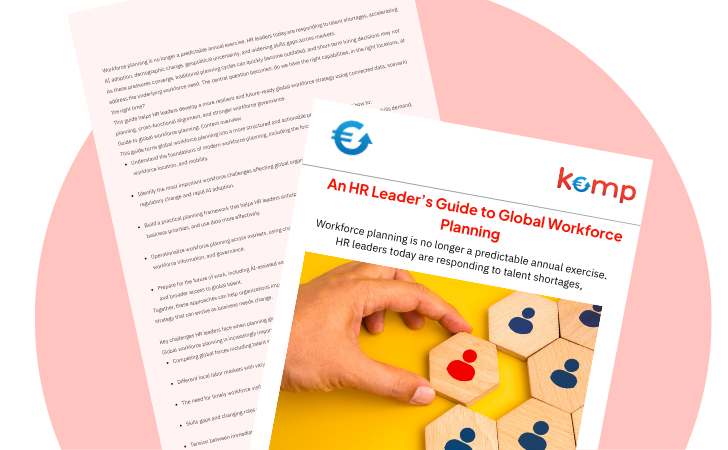
An HR Leader’s Guide to Global Workforce Planning

Workforce planning is no longer a predictable annual exercise. HR leaders today are responding to talent shortages, accelerating AI adoption, demographic change, geopolitical uncertainty, and widening skills gaps across markets.

As these pressures converge, traditional planning cycles can quickly become outdated, and short-term hiring decisions may not address the underlying workforce need. The central question becomes: do we have the right capabilities, in the right locations, at the right time?

This guide helps HR leaders develop a more resilient and future-ready global workforce strategy using connected data, scenario planning, cross-functional alignment, and stronger workforce governance.

Guide to global workforce planning: Content overview

This guide turns global workforce planning into a more structured and actionable process. You’ll learn how to:

  • Understand the foundations of modern workforce planning, including the forces changing talent availability, skills demand, workforce location, and mobility.
  • Identify the most important workforce challenges affecting global organizations, from skills shortages and cost pressure to regulatory change and rapid AI adoption.
  • Build a practical planning framework that helps HR leaders anticipate future workforce needs, connect talent decisions to business priorities, and use data more effectively.
  • Operationalize workforce planning across markets, using cross-functional collaboration, scenario planning, connected workforce information, and governance.
  • Prepare for the future of work, including AI-assisted workforce intelligence, demographic shifts, flexible workforce models, and broader access to global talent.

Together, these approaches can help organizations improve workforce resilience, allocate talent more effectively, and create a strategy that can evolve as business needs change.

Key challenges HR leaders face when planning globally

Global workforce planning is increasingly important, but it also involves greater complexity. HR leaders must account for:

  • Competing global forces including talent shortages, automation, demographic changes, and financial constraints
  • Different local labor markets with varying workforce costs, regulations, talent availability, and employment practices
  • The need for timely workforce visibility as business and market conditions continue to change
  • Skills gaps and changing roles driven by AI adoption and broader digital transformation
  • Tension between immediate workforce needs and long-term planning
  • Pressure to increase capability while controlling workforce costs, often within fixed headcount and budget limitations

This guide explains how to bring these considerations together and create a workforce plan that remains scalable, adaptable, and aligned with long-term business priorities.

Who is this guide for

This guide supports leaders involved in building or executing a global workforce strategy:

  1. HR and People leaders will learn how to establish a structured workforce planning process that supports talent readiness, changing business requirements, and more informed workforce decisions.  
  1. Workforce Planning, Operations & Analytics teams will gain a scalable framework for forecasting talent demand, evaluating different scenarios, and aligning workforce resources with future priorities.  
  1. Executives and business leaders can use this guide to better understand the workforce risks, costs, and opportunities associated with global growth and changing business strategies.  
  1. Global talent and mobility leaders will learn how to evaluate where, when, and through which workforce model talent should be deployed across different countries.  

Get the guide to learn how organizations can move from reactive headcount decisions toward more strategic global workforce planning supported by connected data, scenario analysis, and workforce visibility.

FAQs

HR leaders can start by translating business priorities, such as entering a new market, launching a product, or expanding a service line, into specific workforce requirements. This includes identifying the skills required, the locations where those skills are needed, expected workforce costs, and appropriate employment models.

From there, HR can build a people plan covering which roles to hire, where those roles should sit, and which capabilities should be developed internally. Ongoing collaboration with Finance and business leaders helps ensure workforce planning supports growth objectives rather than operating as a separate HR exercise.

Start with expected business demand by region, including expansion plans, customer requirements, product development, projects, and regulatory changes. Then compare those needs against existing workforce supply, such as headcount, skills, attrition, contractor usage, and internal mobility.

Scenario planning can then test different outcomes, such as faster market growth or higher attrition in a particular region. This allows HR teams to create a clearer view of future talent gaps by role, skill, geography, and timing.

HR teams typically need:

  1. Core workforce data: Current headcount by geography and function, job levels, attrition history, and internal mobility.
  2. Workforce cost data: Salary, employer costs, benefits, payroll taxes, and other employment costs by location.
  3. Market information: Compensation benchmarks, talent availability, and demand for important skills.
  4. Business demand data: Hiring plans, project pipelines, growth targets, and approved budgets.
  5. Performance and productivity information: Relevant measures that help connect workforce investment with business outcomes.

Combining these data points gives leaders a clearer basis for deciding how many people are needed, where they should be located, and the expected workforce cost.

HR teams can use scenario-based workforce planning rather than relying on a single fixed forecast. This may include creating growth, baseline, and contraction scenarios and understanding how each would affect workforce demand and cost.

Critical roles can be prioritized while other requirements may be evaluated through employees, contractors, contingent talent, or other workforce models where appropriate. Close coordination with Finance also helps teams monitor changing labor costs, budgets, and business conditions without losing sight of longer-term workforce priorities.

HR teams can build flexibility through:

  • Flexible workforce capacity, including contractors or contingent workers where appropriate.
  • Cross-skilled internal employees who can move between teams, projects, or locations.
  • Scenario planning covering different growth and contraction outcomes, with defined triggers for adjusting workforce plans.

Using rolling planning cycles instead of treating the annual workforce plan as fixed can also help teams review assumptions regularly and adjust as business conditions evolve.

A more agile workforce planning model uses recurring reviews rather than depending entirely on annual planning cycles. HR teams can maintain flexibility through a mix of workforce models, stronger internal mobility, cross-skilling, and scenario planning.

Connected workforce data and timely reporting also make it easier to understand how changes in cost, demand, attrition, or workforce location affect the plan without rebuilding the entire planning process each time conditions shift.

Important considerations when planning across employees, contractors, freelancers, and other worker types include:

  • Legal and compliance requirements: Worker classification, employment obligations, and potential tax exposure across jurisdictions.
  • Different cost structures: Each worker model can carry different direct and indirect workforce costs.
  • Skills availability and flexibility: Certain workforce models may provide faster access to specialized capabilities.
  • Workforce visibility: Employee and contractor information may otherwise sit across separate systems and processes.
  • Role within the broader workforce strategy: Organizations should define when each worker model is appropriate rather than treating non-employees as an isolated workforce category.

Considering these differences from the beginning helps reduce gaps in workforce planning and governance.

To involve Finance and business leaders effectively:

  1. Bring them into the process early: Workforce planning should operate as a shared business process rather than an HR-only activity.
  2. Connect workforce decisions to business outcomes: Translate headcount into cost, roles into capability, and hiring timelines into operational impact.
  3. Create shared workforce visibility: Provide relevant information on headcount, geography, workforce cost, and planned changes.
  4. Run joint planning discussions: HR, Finance, and business teams can evaluate workforce scenarios alongside budgets, business priorities, and strategic milestones.

Organizations should look for workforce platforms that can bring together:

  • Multi-country workforce information across employees, contractors, and other workforce structures.
  • Workforce reporting and analytics covering headcount, location, cost, and employment models.
  • Structured workflows for workforce changes, approvals, and employment processes.
  • Connections between workforce information, payroll, compliance, and finance operations.
  • AI-assisted insights that surface workforce information for human review and decision-making.

Komp brings payroll, EOR, contractor management, workforce information, compliance workflows, and AI-assisted workforce intelligence into a connected Workforce Operating System. This can reduce reliance on disconnected spreadsheets and give HR, Finance, and business leaders stronger visibility across global workforce operations.

Geopolitical developments and regulatory changes can affect labor rules, taxation, data requirements, employee mobility, and operational stability in different countries.

When deciding where to hire or deploy talent, HR teams should consider workforce cost alongside compliance requirements and broader market conditions. Building alternative workforce-location scenarios can also help organizations respond if a particular market becomes less practical for hiring or operating.

Useful workforce indicators can include:

  • Unplanned absence patterns.
  • Employee engagement and wellbeing survey results.
  • Voluntary turnover trends.
  • Manager-to-employee ratios.
  • Overtime and extended-hours patterns.
  • Paid time off usage and accumulated leave.

Viewed together, these signals can help HR leaders identify emerging workforce pressures and investigate potential talent risks before they develop into larger retention or productivity issues.

Your Details

Realted Resources

Left-pointing arrow icon.
Right-pointing arrow icon.