Guide

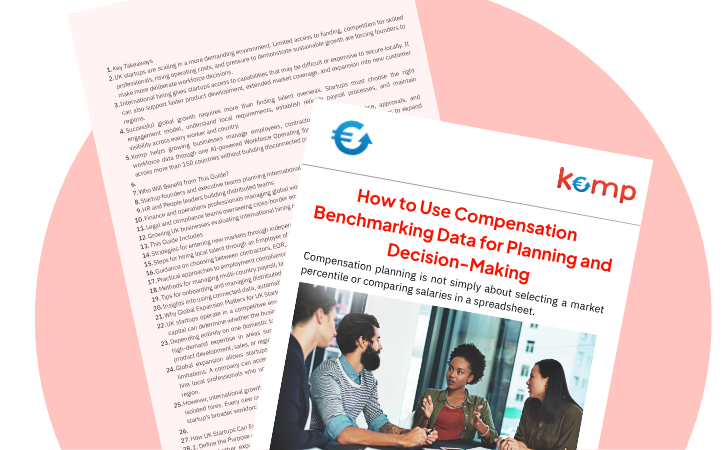
How to Use Compensation Benchmarking Data for Planning and Decision-Making

Compensation planning is not simply about selecting a market percentile or comparing salaries in a spreadsheet. Every decision must balance business affordability, talent competitiveness, internal consistency, employee expectations, and local requirements.

The challenge is rarely a lack of data. It is knowing which data is relevant, how to interpret it, and how to apply it consistently across roles, locations, and workforce groups.

Outdated benchmarks, inaccurate job matches, and inconsistent decision-making can lead to uncompetitive offers, unexplained pay differences, rising workforce costs, and reduced employee trust.

This guide helps HR, finance, and business leaders turn compensation benchmarking data into a practical decision-making framework. Use it when designing salary ranges, reviewing internal equity, preparing offers, planning merit increases, or expanding into new talent markets.

Guide Overview

This guide provides a practical framework for understanding, evaluating, and applying compensation data across the employee lifecycle.

Rather than treating market benchmarks as fixed answers, the guide explains how to use them as one input within a broader compensation strategy.

Inside this guide, you’ll find:

  • A practical glossary of compensation and benchmarking terminology
  • An explanation of how compensation datasets are developed
  • Guidance for assessing the reliability and relevance of market data
  • Steps for matching internal roles with external benchmark positions
  • Methods for building salary ranges and compensation bands
  • Ways to apply benchmarking data to hiring offers and merit cycles
  • Guidance for reviewing internal equity and identifying pay inconsistencies
  • Common compensation benchmarking mistakes and how to avoid them
  • Considerations for location-based and global compensation planning
  • A framework for aligning HR, finance, and business leaders around pay decisions

Use the glossary to establish a shared understanding across stakeholders, then move to the sections most relevant to your current priority - whether that is building pay bands, entering a new market, reviewing salary gaps, or preparing your next compensation cycle.

Practical tip: Involve finance and business leadership early. Compensation frameworks are more effective when talent priorities, workforce budgets, and business plans are considered together.

Who Is This Guide For?

This guide is ideal for:

  • People and HR leaders managing compensation across growing teams
  • Compensation and benefits teams building or reviewing salary structures
  • Talent acquisition leaders creating competitive and consistent offers
  • Finance and executive teams aligning pay decisions with workforce budgets
  • Anyone developing or refreshing a global compensation framework

Common Compensation Benchmarking Mistakes

  • Relying Only on Job Titles: Titles can differ significantly between organizations. Benchmark the role’s actual scope and responsibilities.
  • Using Outdated Market Data: Older data may no longer reflect current talent conditions, especially for fast-changing or highly specialized roles.
  • Treating Benchmarks as Fixed Answers: Market data provides a reference point. It should be interpreted alongside internal equity, business strategy, and affordability.
  • Ignoring Total Compensation: Base salary is only one component. Incentives, benefits, allowances, equity, and other rewards may materially affect competitiveness.
  • Applying One Approach Everywhere: Compensation markets differ by country, city, industry, skill set, and employment model. A single global figure may not reflect local realities.
  • Overlooking Internal Equity: Matching external market rates without reviewing existing employee pay can create inconsistencies and retention risks.
  • Making Exceptions Without Documentation: Unrecorded exceptions can quickly weaken the integrity of the compensation framework.

How Komp Supports More Informed Workforce Decisions

We connect workforce data, compensation information, approvals, compliance, and reporting through one Workforce Operating System.

With us, organizations can:

  • Create a Connected Workforce View: Bring employee, contractor, location, role, and compensation information into a more consistent operating environment.
  • Improve Compensation Visibility: Review workforce costs and compensation information across teams, countries, worker types, and organizational structures.
  • Strengthen Approval Governance: Apply structured workflows and decision controls to compensation changes, offers, and workforce actions.
  • Support Global Planning: Connect compensation decisions with workforce expansion, budgeting, payroll, compliance, and operational requirements across markets.
  • Reduce Fragmented Decision-Making: Give HR, finance, and business leaders access to more consistent workforce information when planning and reviewing compensation.

FAQs

Compensation benchmarking is the process of comparing an organization's pay for specific roles with relevant external market data.

The comparison can include base salary, incentives, benefits, and total compensation. The purpose is to understand how internal pay aligns with the market and use that insight to support salary ranges, hiring decisions, workforce planning, and internal equity reviews.

Salary benchmarking usually focuses on base pay.

Compensation benchmarking considers a broader package, which may include:

  • Base salary
  • Performance incentives
  • Bonuses
  • Commission
  • Equity
  • Benefits
  • Allowances
  • Other rewards

Looking only at salary may create an incomplete picture when different organizations structure total rewards differently.

Benchmarking a role means matching an internal position with a comparable role in an external compensation dataset.

The match should be based on responsibilities, scope, seniority, skills, complexity, and organizational impact—not only the job title.

A reliable role match is essential because inaccurate matching can distort salary ranges and compensation decisions.

The first step is to define the role accurately.

Review the job description, responsibilities, seniority, required capabilities, reporting structure, and business impact. Once the internal role is clear, it can be matched more reliably with external market positions.

They typically:

  • Define the roles and levels to be reviewed
  • Select reliable compensation data sources
  • Match internal roles with external benchmark roles
  • Choose relevant comparison markets
  • Review market percentiles
  • Compare external data with internal pay
  • Establish or update salary ranges
  • Document the methodology and decisions

The process should be reviewed periodically as roles and talent markets change.

There is no single percentile that is appropriate for every organization or role.

Many use the market median as a reference point, while others position pay above or below it depending on talent strategy, skill scarcity, business criticality, location, benefits, and affordability.

The important step is to define a consistent compensation philosophy rather than choosing a percentile differently for every decision.

Many organizations review compensation data annually, often before budgeting or merit-planning cycles.

More frequent review may be appropriate when:

  • Talent markets are changing quickly
  • The organization is entering new countries
  • Critical roles are difficult to fill
  • Employee turnover is increasing
  • Pay-transparency requirements are evolving
  • Major workforce restructuring is taking place

Yes. Benchmarking can help reveal employees or groups whose compensation falls outside expected market or internal ranges.

However, external data alone does not determine whether a pay difference is justified. Organizations should also review factors such as role scope, experience, performance, tenure, location, and documented business rationale.

Benchmarking establishes external reference points, while internal equity reviews compare employees performing similar or comparable work within the organization.

Used together, these approaches help identify inconsistent pay decisions, compression, range exceptions, and unexplained differences that may require further review.

Compensation data should help establish the approved range for the role.

The final offer should then consider:

  • Candidate experience
  • Relevant capabilities
  • Internal peer compensation
  • Position within the range
  • Location
  • Talent availability
  • Total rewards
  • Budget
  • Future progression

This helps avoid basing offers only on salary history or candidate expectations.

A reliable source should provide:

  • Recent data
  • Clear methodology
  • Aggregated and anonymized information
  • Relevant job definitions
  • Appropriate geographic coverage
  • Meaningful sample sizes
  • Clear market segmentation
  • Transparent update frequency

No dataset is perfect, so organizations should understand its limitations before using it for decisions.

Compensation benchmarking is generally conducted using aggregated, anonymized information from established providers.

Organizations should avoid directly exchanging sensitive, current compensation information with competitors, as this may create competition-law or antitrust concerns.

Legal requirements differ by jurisdiction, so organizations should seek appropriate legal advice when designing benchmarking practices or participating in salary-data exchanges.

Responsibility usually sits with HR, Compensation and Benefits, or People Operations teams.

Finance, Talent Acquisition, business leadership, and external advisers may also participate, particularly when benchmarking supports annual planning, workforce expansion, organizational redesign, or major compensation changes.

Salary compression occurs when there is little difference between the pay of newer employees and more experienced employees, or between employees at different levels.

It can develop when market rates rise quickly and new-hire offers increase faster than existing employee salaries. Benchmarking combined with internal equity analysis can help identify and address this issue.

We help organizations connect workforce, role, location, compensation, approval, payroll, and reporting information through one Workforce Operating System.

  • Create a Connected Workforce View: Bring employee, contractor, location, role, and compensation information into a more consistent operating environment.
  • Improve Compensation Visibility: Review workforce costs and compensation information across teams, countries, worker types, and organizational structures.
  • Strengthen Approval Governance: Apply structured workflows and decision controls to compensation changes, offers, and workforce actions.
  • Support Global Planning: Connect compensation decisions with workforce expansion, budgeting, payroll, compliance, and operational requirements across markets.
  • Reduce Fragmented Decision-Making: Give HR, finance, and business leaders access to more consistent workforce information when planning and reviewing compensation.

Your Details

Realted Resources

Left-pointing arrow icon.
Right-pointing arrow icon.