Guide

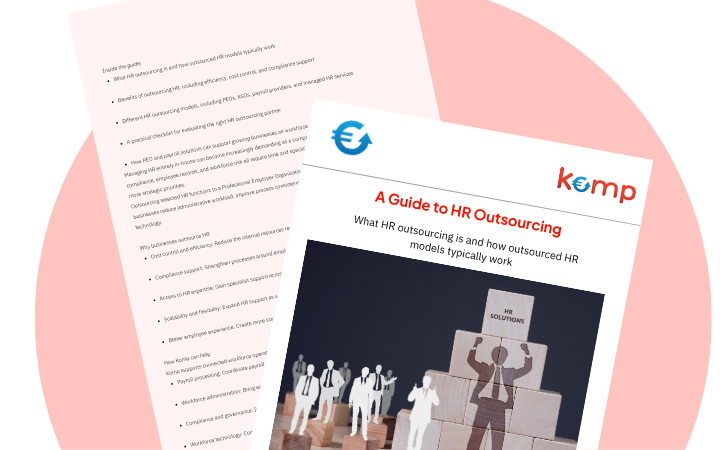
A Guide to HR Outsourcing

Inside the guide:

  • What HR outsourcing is and how outsourced HR models typically work
  • Benefits of outsourcing HR, including efficiency, cost control, and compliance support
  • Different HR outsourcing models, including PEOs, ASOs, payroll providers, and managed HR services
  • A practical checklist for evaluating the right HR outsourcing partner
  • How PEO and payroll solutions can support growing businesses as workforce complexity increases

Managing HR entirely in-house can become increasingly demanding as a company grows. Payroll, benefits administration, compliance, employee records, and workforce risk all require time and specialist attention that can pull internal teams away from more strategic priorities.

Outsourcing selected HR functions to a Professional Employer Organization (PEO) or another HR services provider can help businesses reduce administrative workload, improve process consistency, and access additional expertise and workforce technology.

Why businesses outsource HR

  • Cost control and efficiency: Reduce the internal resources required to manage recurring HR administration
  • Compliance support: Strengthen processes around employment requirements, payroll obligations, and regulatory changes
  • Access to HR expertise: Gain specialist support across areas such as payroll, benefits, workforce risk, and HR operations
  • Scalability and flexibility: Expand HR support as workforce size and operational complexity increase
  • Better employee experience: Create more consistent payroll, benefits, and everyday HR processes for employees

How Komp can help

Komp supports connected workforce operations across:

  • Payroll processing: Coordinate payroll with workforce data, documentation, and compliance requirements
  • Workforce administration: Bring employee and worker information into a more connected operating environment
  • Compliance and governance: Improve visibility into workforce requirements, documentation, and compliance workflows
  • Workforce technology: Connect global payroll, EOR, contractor management, and workforce information within one broader system
  • Operational support: Help HR teams manage workforce processes with greater consistency, visibility, and control

Who should download this guide?

  • Small business owners looking to reduce time spent on recurring HR administration
  • Companies dealing with increasingly complex HR, payroll, and compliance processes
  • Businesses evaluating whether a PEO or another outsourced HR model fits their needs
  • HR leaders looking to improve processes and create more scalable workforce operations

FAQs

HR outsourcing means using an external provider to manage selected HR functions such as payroll, benefits administration, compliance, recruitment, or workforce administration.

HR outsourcing can be valuable for organizations looking to reduce administrative workload, access specialist expertise, strengthen compliance processes, and allow internal teams to focus on higher-value business and workforce priorities.

Costs depend on the provider, service scope, workforce size, and pricing model. Some PEOs charge based on payroll or employee count, while other HR outsourcing providers may use flat fees, per-employee pricing, or service-based structures.

HR outsourcing can generally be divided into full-service and partial models. Full-service arrangements provide broader HR administration, while partial outsourcing allows organizations to delegate specific functions such as payroll, benefits, or specialist HR support.

An HRO (Human Resource Outsourcing) provider delivers outsourced HR services without entering a co-employment relationship. A PEO, by comparison, operates through co-employment and typically assumes responsibility for agreed functions such as payroll administration, benefits, and certain employment-related compliance processes.

Your Details

Realted Resources

Left-pointing arrow icon.
Right-pointing arrow icon.