Guide

Employer of Record for Field Workers: A Buyer’s Guide

Most Employer of Record solutions are designed around office-based or remote workforces. Field deployments are different. When workers are operating on construction sites, industrial facilities, energy projects, mines, or other physical environments, organizations must evaluate far more than standard employment and payroll capabilities.

This buyer’s guide gives procurement, operations, legal, and project teams a practical framework for assessing whether an EOR can support mobile, project-based, and field-deployed workforces. It focuses on the questions that matter most before a provider is selected, including liability, mobilization, payroll, compliance, immigration, and commercial transparency.

Guide Overview

Choosing an Employer of Record for field and industrial roles is a high-impact operational decision.

A delayed mobilization can affect project timelines. Payroll errors across rotational schedules can create workforce disruption. Weak local compliance support or unclear liability structures can expose the organization when issues arise on site.

This guide covers:

  • Why standard EOR evaluation criteria are not enough for mobile, project-based, and field-deployed workforces
  • Six areas to assess when evaluating a field EOR, including on-site liability, mobilization capability, rotational payroll, host-country compliance, immigration support, and pricing transparency
  • The questions procurement, legal, and operations teams should ask each provider
  • A scored evaluation framework that can be applied across multiple EOR vendors
  • A red-flag checklist highlighting responses that may indicate operational or compliance gaps

Komp supports global workforce operations through Employer of Record, contractor management, payroll, compliance, and centralized workforce visibility across 150+ countries. For field deployments, organizations should evaluate country-specific requirements, role risk, employment structure, and operational responsibilities before proceeding.

Who Will Benefit from This Guide

  • EPC Firms and Project Operators Evaluating EOR Providers: A structured way to compare workforce partners before mobilization begins
  • Procurement and Legal Teams: Practical questions around liability, local compliance, employment structure, and commercial transparency
  • Project Managers and Site Leaders: Guidance on what an EOR should support across payroll, mobilization, workforce documentation, and escalation
  • Finance and Operations Leaders Overseeing Multi-Country Deployments: A clearer framework for evaluating deployment costs, payroll complexity, and provider responsibilities

Explore Komp to understand how global EOR, payroll, and workforce operations can support international project teams.

FAQs

An Employer of Record becomes the legal employer of workers in a country where the client organization may not have its own employing entity. The EOR typically manages employment contracts, payroll, taxes, statutory obligations, and local employment compliance while the client directs day-to-day work.

For field deployments, organizations should also evaluate how the provider handles role-specific risk, local site requirements, rotational schedules, workforce documentation, and other obligations that may not apply to standard office-based workers.

Start by confirming whether the provider supports the specific worker roles and site environments involved in your deployment. Field work may create additional liability, insurance, payroll, health and safety, immigration, or local compliance requirements.

Ask providers how they handle these responsibilities, whether they support rotational or project-based payroll structures, what local expertise is available, and where responsibility sits if an issue occurs during the deployment.

Komp provides EOR, contractor management, payroll, compliance, workforce documentation, and centralized workforce visibility through one connected operating environment.

For field-based or industrial roles, deployment requirements can vary significantly by country, worksite, worker classification, and risk profile. Komp can support the broader employment and workforce operating model, while specific field requirements should be assessed for each deployment before workers are engaged.

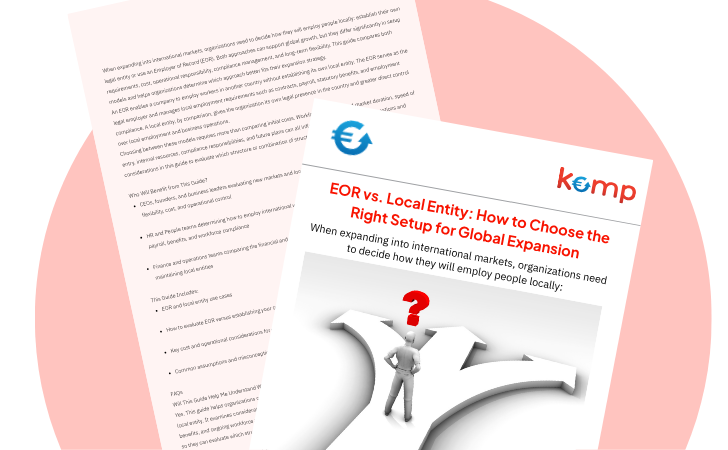
An EOR can be useful when an organization needs to deploy workers into a country without first establishing its own legal entity. This can be particularly relevant for project-based work, market entry, temporary workforce requirements, or locations where long-term headcount is uncertain.

A local entity may become more appropriate when operations are expected to continue for a sustained period, headcount becomes significant, or the organization requires direct local employment infrastructure. The right decision depends on duration, workforce scale, cost, risk, and country-specific requirements.

A capable provider should demonstrate a clear understanding of the employment, payroll, immigration, statutory, and workforce requirements that apply in the relevant country.

For field deployments, organizations should also clarify whether local workforce ratios, site access requirements, union obligations, worker documentation, or other project-specific rules apply. Ask how these requirements are monitored, who provides local expertise, and how changes are communicated during the project.

The most important question is whether the provider can support the actual deployment model rather than simply offering general EOR coverage.

Legal employer responsibility. Understand who carries employment obligations in the host country and what responsibilities remain with your organization.

Role and site risk. Confirm whether the provider supports the specific work environment and worker classifications involved.

Payroll capability. Determine whether payroll can accommodate rotational schedules, allowances, variable payments, and multiple currencies where required.

Local compliance support. Understand how employment, immigration, statutory, and country-specific requirements are managed.

Commercial transparency. Request a clear breakdown of fees, pass-through costs, and responsibilities before signing.

Providers should be able to explain each area clearly and document how their operating model works.

Warning signs include a provider being unable to explain who carries employment responsibility, uncertainty around whether specific field roles are supported, unclear payroll capabilities for project-based work, limited visibility into local compliance support, or pricing that does not clearly distinguish service fees from pass-through costs.

For higher-risk deployments, organizations should also be cautious if escalation processes, documentation responsibilities, or country-specific operational requirements remain undefined.

Your Details

Realted Resources

Left-pointing arrow icon.
Right-pointing arrow icon.