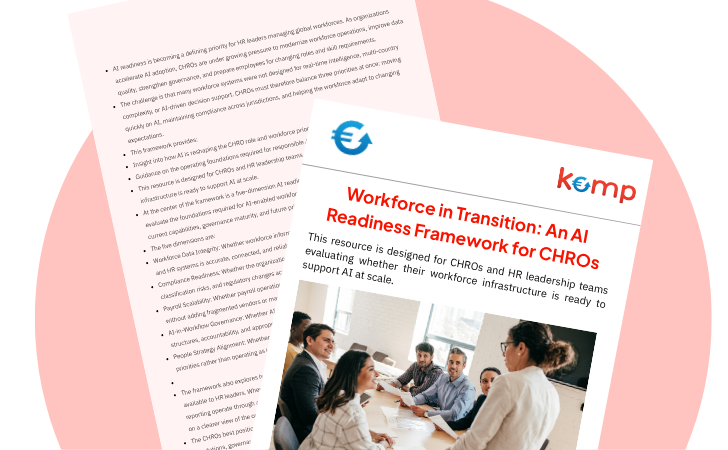
AI readiness is becoming a defining priority for HR leaders managing global workforces. As organizations accelerate AI adoption, CHROs are under growing pressure to modernize workforce operations, improve data quality, strengthen governance, and prepare employees for changing roles and skill requirements.
The challenge is that many workforce systems were not designed for real-time intelligence, multi-country complexity, or AI-driven decision support. CHROs must therefore balance three priorities at once: moving quickly on AI, maintaining compliance across jurisdictions, and helping the workforce adapt to changing expectations.
This framework provides:
- Insight into how AI is reshaping the CHRO role and workforce priorities
- Guidance on the operating foundations required for responsible AI-enabled workforce management
- A practical framework for assessing and improving organizational AI readiness
“We were already investing in AI, but our workforce data, payroll, and compliance processes were still fragmented across systems. Komp helped us bring those foundations together, giving our HR team clearer visibility, stronger governance, and the confidence to introduce AI into workforce operations without losing human oversight.”
- CHRO
Global Technology & Services Company
Inside the AI Readiness Framework
This resource is designed for CHROs and HR leadership teams evaluating whether their workforce infrastructure is ready to support AI at scale.
At the center of the framework is a five-dimension AI readiness assessment that helps organizations evaluate the foundations required for AI-enabled workforce operations. Each area can be reviewed against current capabilities, governance maturity, and future priorities.
The five dimensions are:
- Workforce Data Integrity: Whether workforce information across payroll, employment models, contractors, and HR systems is accurate, connected, and reliable enough to support AI-driven insights
- Compliance Readiness: Whether the organization can monitor workforce obligations, documentation, classification risks, and regulatory changes across multiple jurisdictions
- Payroll Scalability: Whether payroll operations can support workforce growth and new-market expansion without adding fragmented vendors or manual workarounds
- AI-in-Workflow Governance: Whether AI is embedded into defined workforce processes with clear approval structures, accountability, and appropriate human oversight
- People Strategy Alignment: Whether AI initiatives are connected to measurable workforce and business priorities rather than operating as isolated technology projects
The framework also explores how connected workforce infrastructure can improve the quality of information available to HR leaders. When payroll, compliance, workforce records, worker classifications, approvals, and reporting operate through a more consistent environment, AI-supported workforce decisions can be based on a clearer view of the organization.
The CHROs best positioned for the AI era will not simply adopt more technology. They will build the data foundations, governance structures, operating models, and workforce capabilities required to use AI with greater confidence and accountability.
Who is this framework for?
- CHROs and Chief People Officers: Responsible for workforce transformation and AI strategy who need a structured way to assess organizational readiness
- HR Directors and People Operations Leaders: Managing global processes across payroll, onboarding, compliance, workforce management, and employee operations
- Enterprise Business and Finance Leaders: Overseeing global expansion, workforce cost visibility, operating efficiency, and compliance across multiple markets
If your organization is operating globally and asking whether its workforce infrastructure is ready to support responsible AI adoption, this framework is designed for you.




.png)
































.png)