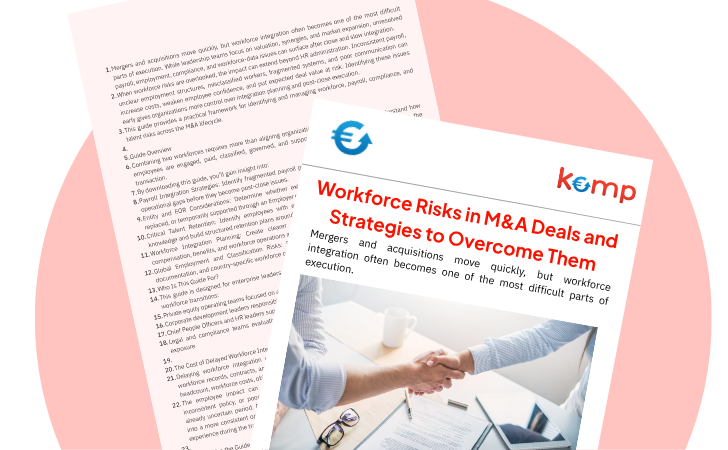
Mergers and acquisitions move quickly, but workforce integration often becomes one of the most difficult parts of execution. While leadership teams focus on valuation, synergies, and market expansion, unresolved payroll, employment, compliance, and workforce-data issues can surface after close and slow integration.
When workforce risks are overlooked, the impact can extend beyond HR administration. Inconsistent payroll, unclear employment structures, misclassified workers, fragmented systems, and poor communication can increase costs, weaken employee confidence, and put expected deal value at risk. Identifying these issues early gives organizations more control over integration planning and post-close execution.
This guide provides a practical framework for identifying and managing workforce, payroll, compliance, and talent risks across the M&A lifecycle.
Guide Overview
Combining two workforces requires more than aligning organizational charts. Buyers must understand how employees are engaged, paid, classified, governed, and supported across every country involved in the transaction.
In this guide, you’ll gain insight into:
- Payroll Integration Strategies: Identify fragmented payroll processes, workforce costs, tax obligations, and operational gaps before they become post-close issues.
- Entity and EOR Considerations: Determine whether existing entities should be retained, consolidated, replaced, or temporarily supported through an Employer of Record.
- Critical Talent Retention: Identify employees with essential skills, client relationships, or institutional knowledge and build structured retention plans around them.
- Workforce Integration Planning: Create clearer processes for aligning policies, employee records, compensation, benefits, and workforce operations across both organizations.
- Global Employment and Classification Risks: Review employment models, contractor arrangements, documentation, and country-specific workforce obligations during due diligence.
Who Is This Guide For?
This guide is designed for enterprise leaders responsible for protecting deal value and managing complex workforce transitions:
- Private equity operating teams focused on accelerating post-deal value creation
- Corporate development leaders responsible for integrating international businesses and workforce structures
- Chief People Officers and HR leaders supporting workforce due diligence and post-close integration
- Legal and compliance teams evaluating employment, classification, payroll, and cross-border workforce exposure
The Cost of Delayed Workforce Integration
Delaying workforce integration can create problems long after the transaction closes. When payroll, workforce records, contracts, and employment data remain fragmented, leadership lacks a reliable view of headcount, workforce costs, obligations, and operational risk across the combined organization.
The employee impact can be equally significant. A missed payment, unclear benefit arrangement, inconsistent policy, or poorly communicated employment change can undermine confidence during an already uncertain period. Bringing workforce data, payroll operations, approvals, and employee processes into a more consistent operating model helps reduce duplication while providing employees with a clearer experience during the transition.
How to Use the Guide
This guide provides practical actions for managing workforce challenges before, during, and after an M&A transaction.
1. Conduct workforce due diligence before close
Review worker populations, payroll structures, employment models, contracts, compensation, benefits, tax obligations, and country coverage. Early visibility helps uncover liabilities and integration requirements before they affect execution.
2. Identify and retain business-critical talent
Determine which employees hold essential expertise, customer relationships, leadership responsibilities, or institutional knowledge. Build clear communication, career pathways, and retention arrangements around those individuals before uncertainty drives attrition.
3. Establish interim workforce infrastructure
If the acquiring organization does not have an entity where acquired employees are located, an Employer of Record can provide continuity while the long-term structure is assessed. This helps avoid unnecessary disruption during integration.
4. Connect workforce, payroll, and compliance data
Reduce manual reconciliation by bringing employee records, payroll information, approvals, contracts, and compliance data into a connected operating environment. Better visibility enables teams to identify exceptions and integration risks earlier.
5. Monitor workforce health throughout integration
Track employee sentiment, voluntary turnover, workforce changes, and operational issues during the transition. Integration plans should evolve when workforce data indicates declining confidence, engagement, or productivity.
Manage M&A Workforce Integration with Komp
Successful transactions depend on how effectively the combined workforce can operate after close. Komp connects workforce data, payroll, compliance, employment models, approvals, and reporting through one AI-powered Workforce Operating System.
Whether integrating a targeted acquisition or managing a complex multinational transaction, Komp helps organizations gain clearer workforce visibility, maintain structured governance, and coordinate global workforce operations across more than 150 countries.



.png)






























.png)