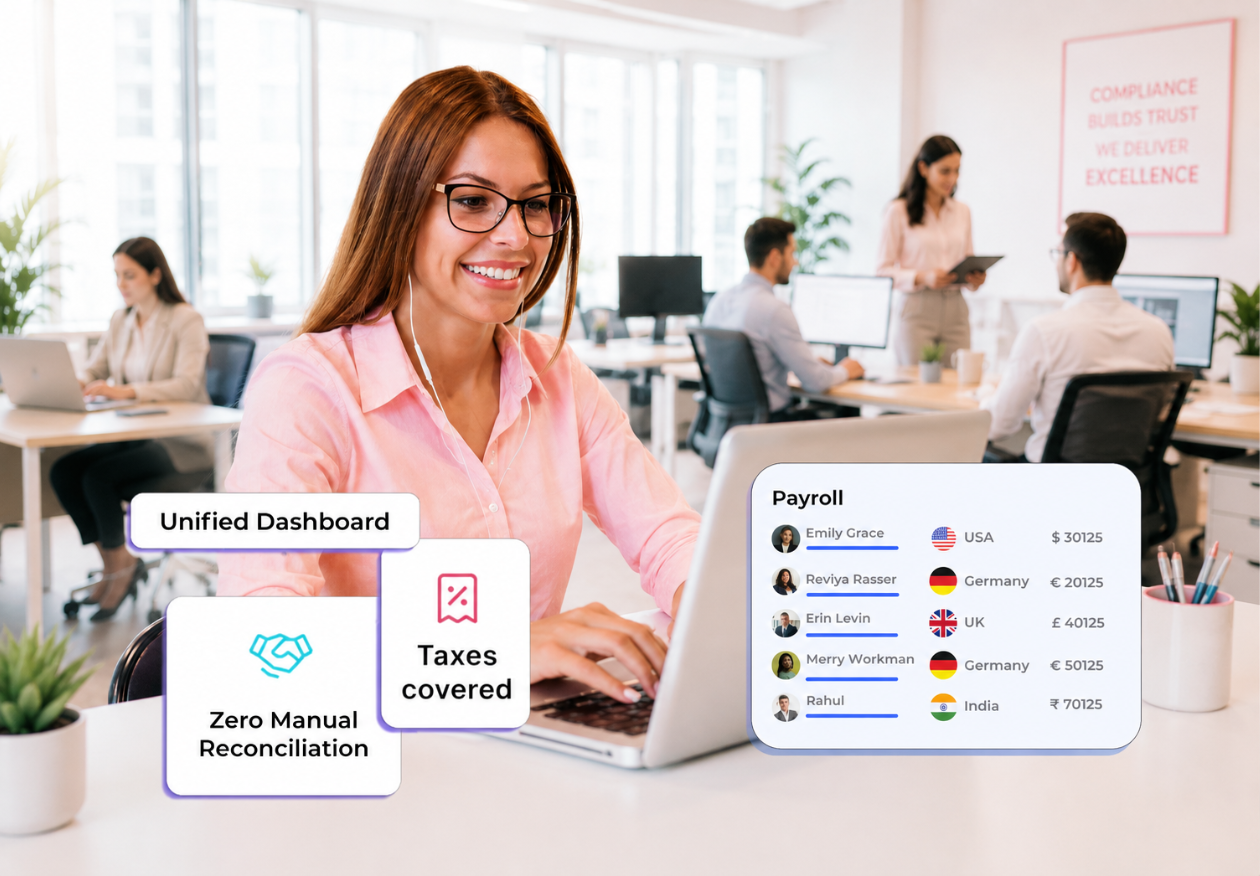
You need to hire in the United States. Your legal team tells you that entity setup may take 3-6 months. Your business team needs talent in 3-6 weeks.
This is the exact situation where most organizations begin searching for ways to hire in the U.S. without opening a local entity. What they often discover too late is that while this is legally possible, it is not operationally simple. The absence of an entity does not remove compliance obligations. It redistributes them.
Global expansion strategies have evolved significantly, but the legal and regulatory architecture governing employment in the United States remains both stringent and highly structured. For many international organizations, the ability to engage U.S. talent without establishing a local legal entity is not merely a matter of convenience; it is a strategic necessity driven by speed, cost efficiency, and flexibility in market entry.
However, what is often overlooked is that hiring without a legal entity is not an absence of structure. It is a reconfiguration of legal responsibility, tax exposure, and accountability for compliance. Organizations that treat it as an operational shortcut frequently encounter regulatory friction that negates the expected benefits.
The central question, therefore, is not whether companies can hire in the United States without a legal entity. Compliance frameworks allow them to do so without incurring tax liabilities, misclassification exposure, or regulatory non-compliance.
The Operational and Compliance Burden Behind U.S. Entity Establishment
Establishing a legal entity in the United States involves much more than just registering a business. It requires federal and state tax enrollment, payroll infrastructure capable of handling FICA, FUTA, and state unemployment insurance, workers’ compensation coverage, benefits administration, and recurring filings such as quarterly Form 941 reports. Employers must also align with layered federal mandates under the Fair Labor Standards Act, Affordable Care Act, OSHA, and Family and Medical Leave Act, while simultaneously complying with state-specific wage, overtime, and leave laws that often exceed federal baselines.
Even though state filing fees for forming an LLC or corporation may appear modest, the true operational setup cost typically ranges between $15,000 and $35,000 upfront, with additional annual maintenance costs that can exceed $30,000 to $100,000 once payroll services, insurance coverage, compliance administration, and advisory support are factored in. Globally, forming an entity can take from 3 to 9 months before hiring a single employee, making this timeline a significant obstacle for organizations that need rapid deployment.
At the same time, the U.S. labor environment adds further complexity. The federal minimum wage remains $7.25 per hour, but states such as California and Washington mandate wages above $16 per hour, requiring employers to track and apply the highest applicable rate. Payroll tax obligations vary by state, and employment termination, while governed by at-will principles, is constrained by federal protections and state “mini-WARN” laws that may require advance notice in workforce reductions under the Worker Adjustment and Retraining Notification Act. The regulatory burden is not theoretical; the U.S. Department of Labor can impose penalties exceeding $2,500 per violation for repeated or willful non-compliance.
This operational weight explains why companies increasingly look for alternatives. In a recent Future of Payroll survey, 43% of global companies cited compliance as their biggest payroll challenge, 34% highlighted the difficulty of managing multi-jurisdiction payroll, and 27% reported process inefficiencies. At the same time, talent scarcity is forcing organizations to look beyond borders. According to ManpowerGroup, 72% of employers worldwide struggle to fill roles, with AI-related skills now among the hardest to source, contributing to a projected global worker shortfall of 85 million people by 2030.
Industry analyses consistently observe that organizations pursue entity-free hiring models to bypass these structural barriers and accelerate workforce deployment. The motivation is understandable: reduce setup time, avoid administrative overhead, and access talent quickly.
However, the absence of a legal entity does not eliminate employer obligations. It redistributes them across alternative engagement frameworks, each carrying its own compliance responsibilities that must be managed with equal rigor and visibility.
U.S. Employment Law: An Enforcement-Driven Compliance Environment
The United States does not provide a neutral or “light-touch” environment for employment. Enforcement is active, multi-layered, and data-driven. Federal authorities such as the Internal Revenue Service and the U.S. Department of Labor, alongside state labor departments and tax agencies, impose strict requirements on how workers are classified, compensated, reported, and, in some cases, how business presence itself is interpreted.
These requirements operate across three critical dimensions:
First, employment tax compliance is non-negotiable. Employers are responsible for accurate withholding and remittance of FICA (7.65%), FUTA (0.6% on the first $7,000), and state unemployment insurance, in addition to quarterly federal filings such as Form 941 and corresponding state reports. Failures are not treated as administrative oversights. Under provisions such as the Trust Fund Recovery Penalty, responsible individuals within a company can be held personally liable for unpaid payroll taxes.
Second, worker classification is a legal determination, not a contractual preference. Federal guidance under the Fair Labor Standards Act and IRS control tests, combined with stricter state standards in jurisdictions like California, determine whether a worker is an employee or an independent contractor. Misclassification can trigger back wages, overtime liabilities, unpaid benefits, tax exposure, and statutory penalties that compound over time. Regulators consistently assess the real working relationship, not the label on a contract. This reality is underscored by the U.S. Department of Labor recovering over $259 million in back wages for nearly 177,000 misclassified workers in FY 2025 - clear evidence that enforcement is not theoretical, but routine and measurable.
Third, nexus and permanent establishment exposure can arise even without a formal entity. When workers operate within the United States on behalf of a foreign company, regulators may assess whether the nature of the activities creates a taxable business presence. This evaluation depends on how work is performed, the authority granted to workers, and the degree of operational integration with the parent organization.
These are not theoretical risks or edge cases. They are actively enforced regulatory standards that define the boundaries within which any entity-free hiring strategy must operate.
Choosing the Right Engagement Model for Entity-Free Hiring in the U.S.
The Employment Structures That Align Operational Reality with U.S. Law
Hiring in the United States without establishing your own legal entity is possible, but only through legally recognized employment structures that reassign, share, or formally assume employer responsibilities. These are not workarounds. They are compliance frameworks designed to ensure that workers engaged in the U.S. are employed, paid, and governed within a structure that regulators recognize as valid.
Employer of Record (EOR): Legal Employment Without Entity Ownership
The Employer of Record model is the most widely adopted and regulator-aligned framework for entity-free hiring in the United States.
Under this structure, a third-party provider becomes the worker’s legal employer. This means the EOR is responsible for:
- Payroll processing and tax withholding
- Federal and state employment tax filings
- Statutory benefits administration
- Employment documentation and labor law compliance
- Ongoing HR and regulatory reporting obligations
From a legal standpoint, this structure aligns operational reality with regulatory expectation. If a worker performs duties that meet the legal definition of employment, they are formally employed within a compliant U.S. entity. This significantly reduces exposure to worker misclassification, payroll tax errors, and reporting failures that often arise in contractor-based or informal hiring approaches.
This alignment matters because regulators assess employment status based on the actual working relationship, not on contractual labels. If an organization directs how work is performed, sets expectations around availability, and integrates the individual into core operations, the relationship may legally qualify as employment regardless of what the contract states. An EOR formalizes that relationship compliantly.
Industry guidance consistently emphasizes that the effectiveness of an EOR model depends not on the label, but on the structure behind it. Fragmented partner networks, indirect employment chains, or unclear allocation of liability between multiple intermediaries can reintroduce the very compliance gaps the model is meant to eliminate.
For this reason, organizations must ensure that the EOR operates as a direct, accountable legal employer with clear responsibility for tax, labor, and employment compliance across all relevant jurisdictions, rather than acting as a coordination layer between the company and a series of local vendors.
Contractor Engagement as a High-Sensitivity Compliance Model
Engaging independent contractors is often perceived as the simplest way to hire without a legal entity. While legally permissible, this approach is also the most misused.
U.S. regulatory frameworks, particularly those enforced by the Internal Revenue Service and the Department of Labor, emphasize that classification is determined by the nature of the working relationship, not by contractual designation. Control over work, financial dependency, and integration into core business functions are all indicators that may shift a contractor relationship into an employment classification. Misclassification risk increases significantly in cross-border hiring scenarios, particularly when organizations apply contractor models to roles that function as employees.
For this reason, contractor engagement should be treated as a narrowly defined model suitable only for genuinely independent, project-based work. It is not a scalable substitute for employment infrastructure.
PEO as Co-Employment: Useful Infrastructure, not a Legal Alternative
The Professional Employer Organization model is often misunderstood in the context of entity-free hiring. Unlike EOR structures, PEOs operate on a co-employment basis, which requires the company to maintain a legal entity in the United States.
While PEOs can significantly reduce administrative burden by managing payroll, benefits, and HR compliance, they do not eliminate the need for entity establishment. As a result, they are not a viable framework for organizations seeking to hire in the U.S. without a legal presence.
The Hidden Risk Layer in Entity-Free Hiring Models
The availability of compliant frameworks, such as Employer of Record, does not eliminate regulatory exposure. It changes where the risk resides. In entity-free hiring, risk is no longer about whether a structure exists but about how well that structure is governed.
One of the most significant exposure points is the creation of an unintended tax nexus or permanent establishment. Even when workers are engaged through an EOR or contractor arrangement, specific activities carried out within the United States, such as revenue generation, contract negotiation, or managerial authority, can create a taxable presence for the foreign company. Remote workforce expansion has made state-level nexus determination far more complex than organizations anticipate.
Misclassification remains another major risk vector. Companies that default to contractor engagement for speed often overlook how day-to-day operational control, dependency, and role integration can legally resemble employment. When this misalignment is identified, regulators may reclassify workers retroactively, triggering cumulative tax liabilities, back wages, and penalties that span months or years.
A third and frequently overlooked issue is compliance fragmentation. When payroll processing, contracts, tax reporting, benefits administration, and workforce oversight are distributed across multiple tools or vendors, visibility diminishes. This fragmentation increases the likelihood of inconsistent reporting, delayed statutory filings, and difficulty responding to audits or regulatory inquiries.
In each of these cases, the framework itself is not the root problem. The risk emerges from the absence of centralized control, unified data visibility, and continuous oversight across the employment structure.
Reframing the Approach: From Access to Accountability
Hiring in the United States without a legal entity should not be approached as a workaround. It should be treated as a structured compliance decision that requires alignment across legal, financial, and operational dimensions.
Organizations that succeed in this model do not simply select an EOR or engage contractors. They evaluate how workforce structure, tax exposure, reporting obligations, and regulatory accountability interact within a unified framework.
This requires a shift from transactional thinking to infrastructure design. Workforce expansion is no longer defined solely by where talent is located, but by how employment relationships are governed.
How Komp Engineers Compliance into Entity-Free Hiring
At Komp, entity-free hiring is approached as a compliance-controlled workforce architecture rather than a collection of operational solutions.
This means that employment structuring, classification assessment, payroll governance, and regulatory monitoring are integrated within a single system designed to maintain alignment from the outset. Rather than distributing responsibility across vendors or relying on post-facto corrections, the model emphasizes proactive control.
Employer of Record frameworks are implemented with clear legal accountability. Contractor engagements are evaluated continuously against U.S. classification standards. Payroll and tax compliance are managed within a unified reporting environment that supports audit readiness and financial transparency.
The objective is not simply to enable hiring without a legal entity. It is to ensure that such hiring operates within a controlled, traceable, and compliant structure that withstands regulatory scrutiny.
Entity-Free Hiring in the U.S.: The Difference Between Possibility and Protection
The ability to hire in the United States without a legal entity is well established. Employer of Record models, contractor engagements, and structured workforce solutions provide viable pathways for global organizations to access U.S. talent.
However, these pathways are not interchangeable, nor are they inherently risk-free. Each framework carries specific legal, tax, and compliance implications that must be understood and managed with precision.
The distinction lies in execution. When entity-free hiring is treated as a speed-driven decision, risk accumulates across classification, taxation, and reporting. When it is treated as a structured compliance framework, it enables both flexibility and control.
For organizations expanding into the United States, the question is no longer whether hiring without a legal entity is possible. It is whether it is being done in a way that preserves regulatory integrity, financial accuracy, and long-term scalability.
In a market defined by both opportunity and enforcement, that distinction is what separates operational access from sustainable expansion.
Not Sure Which Model Fits Your U.S. Hiring Plan?
Komp helps global companies design entity-free hiring structures that align with U.S. tax, labor, and classification laws from day one.
Talk to Komp's compliance team to map the right hiring structure before you make the wrong one.
Works Cited
- U.S. Department of Labor. “Wage and Hour Division: Misclassification of Employees as Independent Contractors.”
- Internal Revenue Service. “Independent Contractor (Self-Employed) or Employee?”
- U.S. Department of Labor. “Fair Labor Standards Act (FLSA) Advisor.”
- U.S. Department of Labor. “Worker Adjustment and Retraining Notification (WARN) Act Compliance Assistance.”
- U.S. Department of Labor. “Family and Medical Leave Act (FMLA) Overview.”
- U.S. Department of Labor. “Occupational Safety and Health Administration (OSHA) Employer Responsibilities.”
- ManpowerGroup. Talent Shortage Survey and Workforce Trends Report. 2025.
- National Conference of State Legislatures. “State Minimum Wage Laws and Employment Regulations.”
- Deel. “Employer of Record in the US: Benefits, Compliance, and How It Works.”
- Papaya Global. “How to Hire International Employees Without a Legal Entity.”
- Playroll. “The United States: Global Hiring Guide.”
- Foothold America. “US Immigration and Compliance for International Employers.”
.png)
 Facebook
 Twitter (X)
 WhatsApp
 LinkedIn
 Copy Link (Insta/Medium)