The Real Business Problem Behind EOR Adoption
When organizations expand into the United States, the first challenge is rarely hiring. It is a legal presence.
Establishing a U.S. entity is not a simple registration task. It brings ongoing obligations across tax registrations, payroll compliance, benefits administration, labor law adherence, reporting requirements, and continuous governance. As noted by Forbes, this burden is both financial and administrative, often delaying market entry and exposing companies to compliance risks before a single employee is hired.
This is the friction point that leads many companies to consider an Employer of Record (EOR) model.
Independent market forecasts show just how rapidly this model is scaling. The global Employer of Record market is valued at $5.8 billion (about $18 per person in the US) in 2025 and is projected to reach $15.6 billion (about $48 per person in the US) by 2034, growing at a 11.6% CAGR. North America alone accounts for 38.4% of global EOR revenues, with the United States representing over 31.5% of that share. This growth is not incidental. It is driven by tightening worker classification rules from the U.S. Department of Labor, state legislation such as California AB5, and the rapid rise of distributed workforce models among startups, scale-ups, and mid-market enterprises.
Market data also shows that 64% of funded technology companies used an EOR provider for at least one international hire in 2025, while an estimated 32% of knowledge workers globally now participate in some form of cross-border employment arrangement. Notably, the Wholly Owned Infrastructure segment holds the largest share of the EOR market at 58.3%, underscoring that compliance strength depends heavily on how directly the legal employer assumes responsibility rather than operating through layered partner networks.
The global EOR market is valued at USD 5.97 billion in 2026 and is projected to reach USD 10.45 billion by 2035, reflecting how rapidly organizations are turning to EOR as a foundational workforce strategy rather than an occasional hiring workaround.
This context matters because, as EOR adoption scales across industries, the consequences of misunderstanding what EOR does and does not protect become significantly larger. What was once an operational shortcut is now a foundational element of global workforce strategy.
The Legal Boundary Between Compliance Protection and Corporate Responsibility
Before examining the false assumptions surrounding Employer of Record (EOR) models in the United States, it is critical to anchor the discussion in what an EOR is legally structured to do.
An Employer of Record is a legally registered U.S. entity that becomes the formal employer of a worker on behalf of another company. That responsibility is not symbolic. It carries statutory, tax, payroll, and labor law accountability under U.S. federal and state regulations.
When implemented correctly, an EOR assumes responsibility for:
- Payroll processing and employment tax withholding (FICA, FUTA, state unemployment insurance)
- Federal and state payroll tax filings and reporting (e.g., Form 941 and state equivalents)
- Statutory benefits administration and workers’ compensation coverage
- Employment documentation compliant with U.S. labor law
- Ongoing adherence to wage, overtime, leave, and termination regulations at both federal and state levels
From a regulatory perspective, this structure matters because it aligns the legal employer with the working reality. If a worker functions as an employee under U.S. legal tests, they are formally employed within a compliant U.S. entity rather than being incorrectly engaged as a contractor or paid through an informal arrangement.
This is where genuine compliance protection originates.
However, this is also where the first major misunderstanding begins.
Many organizations interpret this transfer of employment responsibility as a transfer of all compliance responsibility. In practice, an EOR does not remove the company from the compliance equation. It changes the distribution of accountability.
The EOR becomes responsible for employment execution. The company remains responsible for how the work is designed, directed, and governed. This distinction is subtle but decisive.
U.S. regulators do not evaluate compliance based solely on who runs payroll. They examine:
- Who directs the work
- Who controls the worker’s role and responsibilities
- Whether the activities performed create tax nexus or permanent establishment exposure
- Whether the worker is functioning in a way that aligns with employment law definitions
An EOR can ensure that wages, taxes, benefits, and filings are handled correctly.
It cannot prevent a company from structuring a role in a way that creates misclassification exposure, tax presence, or regulatory scrutiny.
This is why leading industry guidance and compliance analyses repeatedly emphasize that EOR is not a shortcut. It is a legal employment infrastructure that must be paired with correct operational governance.
When organizations treat EOR as a payroll solution, risk accumulates.
When organizations treat EOR as a compliance framework that must be aligned with how work is performed, risk is reduced significantly.
Understanding this boundary is essential before examining the common assumptions that often lead companies to overestimate what an EOR protects and underestimate where their own accountability remains.
The Most Common False Assumptions About EOR in the United States
Organizations are not misusing EOR because the model is flawed, but because they misunderstand what it protects. These misunderstandings create a dangerous gap between legal employment coverage and operational accountability.
Assumption 1: “An EOR Eliminates All Compliance Risk”
This is the most widespread misconception.
An EOR ensures that payroll, tax withholding, statutory benefits, and employment documentation are handled correctly within a U.S. legal entity. That is significant compliance protection.
But it does not eliminate:
- Misclassification exposure if roles are structured like contractors in practice
- Tax nexus or permanent establishment risks created by business activities in the U.S.
- Regulatory scrutiny arising from how work is directed and controlled
Regulators evaluate the working relationship, not the presence of an EOR contract. If operational reality contradicts employment structure, the company, not the EOR, faces exposure.
Assumption 2: “All EOR Providers Offer the Same Level of Protection”
Market overviews and provider comparisons consistently show fragmentation in how EOR services are delivered. Some operate through layered partner networks. Others rely on indirect employment chains across jurisdictions.
This matters because compliance strength depends on who the legal employer is and how directly they assume responsibility. If accountability is diffused across multiple intermediaries, the structure can reintroduce the very compliance gaps the EOR model is meant to solve.
EOR effectiveness is not defined by the label but by the legal clarity and governance behind the structure.
Assumption 3: “EOR Is Primarily a Payroll Solution”
Many organizations first encounter EOR through payroll conversations. This leads to a critical underestimation of its legal role. EOR is a legal employment framework.
Reducing it to payroll ignores:
- Employment law alignment across federal and state jurisdictions
- Benefits and workers’ compensation obligations
- Termination protections and wage-hour compliance
- Ongoing statutory reporting and audit readiness
When treated as payroll infrastructure, companies fail to align their workforce design with the compliance architecture EOR provides.
Assumption 4: “Using an EOR Means the Company Has No U.S. Presence Risk”
Even without a legal entity, companies can create taxable presence in the U.S. based on what workers are authorized to do.
Activities such as:
- Revenue generation
- Contract negotiation
- Managerial authority
- Strategic decision-making conducted from within the U.S.
can trigger nexus assessments regardless of the EOR structure.
Assumption 5: “Contractors and EOR Are Interchangeable for Speed”
Some organizations mix contractor engagements and EOR hiring interchangeably, assuming both achieve the same outcome: entity-free access to talent.
They sit at opposite ends of the compliance spectrum.
- Contractor engagement is viable only for genuinely independent, project-based work.
- EOR is designed for roles that legally resemble employment.
Using contractors for employee-like roles because it feels faster often results in retroactive reclassification, back wages, and tax liabilities that far exceed the perceived convenience.
Where the Misunderstanding Comes From
These assumptions arise because companies approach EOR as a shortcut to hiring, rather than as a structured compliance infrastructure. EOR redistributes responsibility across a legally recognized employment structure that must be matched by correct operational governance. When that alignment exists, EOR provides powerful compliance protection. When it does not, organizations overestimate what EOR covers and underestimate where their own accountability remains.
This gap between perception and legal reality is where most EOR-related compliance failures originate, and where a more structured approach to workforce governance becomes essential.
What Properly Governed EOR Usage Looks Like in Practice
The first requirement is clarity in role design. Before an EOR is even engaged, organizations must examine the substance of the role they intend to create. If the individual will work within fixed structures, report into internal management, contribute to core business operations, and perform work under direct company supervision, then the role is employment in practice. In such cases, an EOR is an appropriate structure because it formally places that employment within a compliant U.S. entity. The governance challenge arises when companies do not perform this evaluation and instead choose engagement models based on speed or convenience. Correct EOR usage begins with recognizing employment reality before the worker is ever onboarded.
The second requirement is continuity in compliance monitoring. Organizations that implement EOR correctly at the beginning often fail to reassess whether the operational reality months later still aligns with the original employment design. Without periodic review, the alignment between legal structure and practical execution slowly erodes. This is where risk accumulates, not because the EOR model is inadequate, but because the relationship between employment structure and work reality is no longer being observed.
The third requirement is unified visibility across employment, payroll, documentation, and governance. When contracts sit in one system, payroll records in another, role definitions with a third team, and compliance oversight with yet another function, inconsistencies emerge. Effective EOR governance requires internal ownership and cross-functional clarity so that finance, HR, legal, and operational teams all have a coherent understanding of how the worker is engaged and why the structure is compliant. The EOR executes employment responsibilities, but the company must maintain visibility into whether that execution continues to reflect how the work is being performed.
The difference between compliance protection and false confidence is not the presence of an EOR agreement. It is the presence of ongoing governance that keeps the legal employment structure and the operational reality in continuous alignment.
How Komp Operationalizes This Governance
Understanding the boundary between EOR compliance scope and enterprise accountability is only the first step. The real challenge for organizations is turning that understanding into a living, repeatable operating model that prevents alignment from eroding as roles evolve, responsibilities expand, and business presence deepens in the United States.
This is where Komp becomes essential.
Komp does not replace an Employer of Record, nor does it serve as another payroll or HR layer. Instead, it functions as an intelligent governance framework that sits between the company and the EOR, ensuring that roles are designed, managed, and evolved to continuously align with the legal employment structure the EOR provides.
Before a role is onboarded through an EOR, Komp evaluates the nature of the work, reporting lines, authority levels, and the position's business impact. This assessment is not static. Using AI-driven compliance logic and classification intelligence, Komp determines whether the engagement model reflects employment reality rather than speed or operational convenience. Roles that properly belong within an EOR structure are identified early, while those that may create tax, nexus, or classification exposure are flagged before risk is introduced into the system.
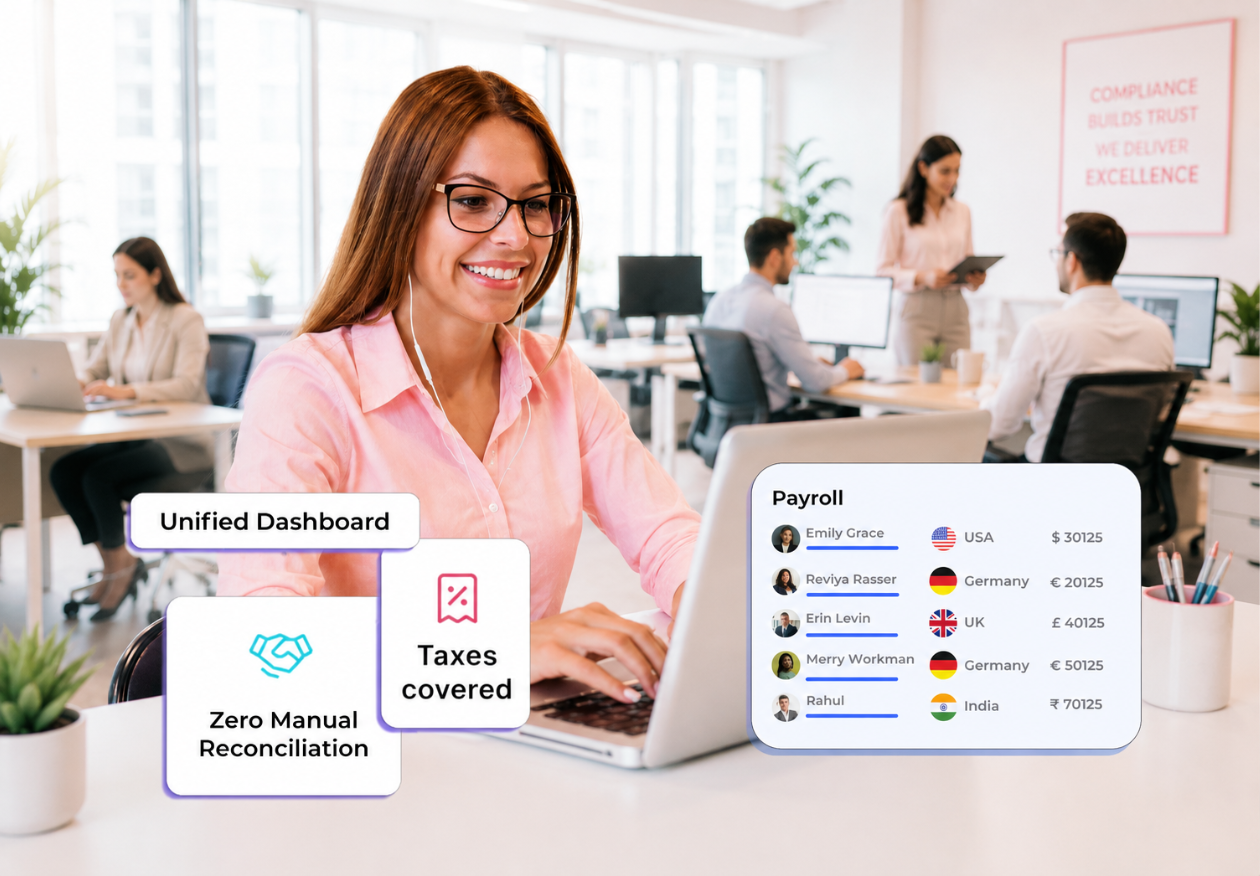
Once the worker is engaged, Komp ensures continuous visibility across payroll accountability, employment documentation, statutory coverage, and regulatory adherence through structured oversight of the EOR relationship. Komp enables organizations to maintain a single, unified view of their EOR workforce across locations, with centralized workforce data, analytics, and compliance signals that reflect evolving regulatory requirements in real time. Dedicated compliance monitoring, structured governance reviews, and multi-channel support visibility ensure that employment execution through the EOR remains transparent, auditable, and aligned with U.S. expectations.
As responsibilities shift, operational control changes, or business functions expand, Komp’s automated compliance monitoring reassesses the role against U.S. employment, tax, and regulatory standards. This prevents the gradual compliance drift that commonly occurs when organizations assume that initial decisions remain valid indefinitely.
Komp also bridges the internal silos that often weaken EOR governance. Legal, HR, finance, and operational teams typically view EOR engagement through different lenses. Komp centralizes workforce data, documentation, classification logic, and compliance signals into a single view, ensuring that employment structure, payroll execution, documentation, and role governance are treated as interconnected components of the same compliance architecture.
Most importantly, Komp ensures that EOR is not treated as a transactional hiring solution, but as a structured employment infrastructure that requires active oversight. It introduces continuous review, intelligent monitoring, and accountability into how EOR is used, transforming what is often a one-time implementation decision into an actively governed workforce model.
This is how organizations move from assuming compliance to systematically maintaining it.
Compliance Protection Requires Governance, Not Assumptions
Employer of Record is one of the most powerful tools available for entering and operating in the United States without establishing a legal entity. When used correctly, it provides real compliance protection by placing employment within a legally registered U.S. framework that manages payroll, taxes, benefits, and statutory obligations.
But EOR was never designed to eliminate the company’s responsibility for how work is structured, directed, and governed.
The false assumptions surrounding EOR arise when organizations treat it as a shortcut to hiring rather than as a compliance infrastructure that must be paired with deliberate workforce governance. This gap between legal employment execution and operational accountability is where most EOR-related risks originate.
The organizations that benefit most from EOR are the ones that understand its legal scope, respect its limitations, and implement governance to ensure continuous alignment between employment structure and operational reality.
That is the difference between compliance protection and compliance exposure.
Komp Simplifies EOR Governance
» Discover how Komp helps you operationalize EOR governance with clarity, structure, and continuous oversight, ensuring your workforce model remains compliant as your business grows.
Works Cited
- Forbes. “Legal Entities: Should You Set Up Your Own?” Forbes Business Council, March 5, 2024.
- DataIntelo. Global Employer of Record Market Report. 2025.
- RemoFirst. “Employer of Record Myths.” Blog post.
- Native Teams. “Employer of Record: Pros and Cons.” Blog post.
- Deel. “Employer of Record: A Complete Guide.” Blog post.
- Deel. “Employer of Record: Risks and How to Avoid Them.” Blog post.
- Deel. “Employer of Record (Glossary).” Resource page.
- Wisemonk. “Employer of Record Compliance.” Blog post.
- GloRoots. “Pros and Cons of Employer of Record (EOR).” Blog post.
- HireArt. “EOR Compliance in the U.S.” Blog post.
- Papaya Global. “EOR Compliance Best Practices: Maintain Legal and Operational Integrity.” Blog post.
- Papaya Global. “Top 10 Best Employer of Record Services.” Blog post.
- Multiplier. “Employer of Record in the United States.” Resource page.
.png)
 Facebook
 Twitter (X)
 WhatsApp
 LinkedIn
 Copy Link (Insta/Medium)